The Wish That Fed 300 Strangers
My husband passed away four years ago. At the time, I thought nothing could hurt more than losing him. Then my eleven-year-old son, Noah, was diagnosed with cancer.
His treatment began with countless hospital visits, painful tests, and long nights filled with uncertainty.
He even celebrated his twelfth birthday in a hospital room.
I bought him some cupcakes from the hospital cafeteria, and he complained that the frosting tasted like toothpaste.
Then he ate two.
That was Noah.
Even when he was scared, he always found something funny to say.
“Mom, I have to get better.”
“And why is that?” I asked.
“Who’s going to leave dirty socks all over the house if I’m not around?”
I laughed.
But a little while later, I stepped into the hallway to cry where he couldn’t see me.
During those difficult weeks, a volunteer from a charitable organization came to visit Noah in his hospital room.
Her organization granted wishes for children living with serious illnesses.
She explained that he could choose something meaningful to him, something that would bring him happiness.
I was certain he’d ask to see the ocean.
After all, he kept a beautiful drawing of the sea beside his bed.
But his answer surprised me.
“Could I give dinner to people who don’t have enough food?” he asked.
The volunteer smiled.
“What kind of dinner?”
“Not sandwiches in little bags. I mean a real dinner, with tables and chairs. And dessert!”
I stared at him in amazement.
“Noah, sweetheart, this is your wish. You could choose something special, just for yourself.”
He shrugged.
“People do things for me every day, Mom. I want to do something for someone else.”
His wish eventually became a plan to provide a meal for 300 people at a local community center.
Noah chose the menu himself.
He insisted on macaroni and cheese, roast chicken, warm bread, and chocolate cake.
He even chose yellow napkins.
He said white ones reminded him too much of the paper used at the hospital.
During the preparations, I noticed that he kept checking his backpack.
Inside was a small keepsake box that he refused to show me.
Whenever I asked what was in it, he simply smiled and said he was preparing a surprise.
One afternoon, I caught him talking quietly with the organization’s coordinator.
As soon as I approached, he quickly closed his backpack.
“What are you two planning?” I asked.
“Napkin business,” he replied.
The coordinator smiled.
“Highly confidential napkin business.”
I laughed, assuming they were arranging another surprise for the dinner.
A few days later, I overheard Noah talking on the phone.
“Please don’t tell my mom yet,” he whispered. “I want to do it myself.”
I wanted to ask him a hundred questions, but I decided to respect his privacy.
Finally, the day of the dinner arrived.
Noah wore his favorite blue sweatshirt and carried his backpack everywhere he went.
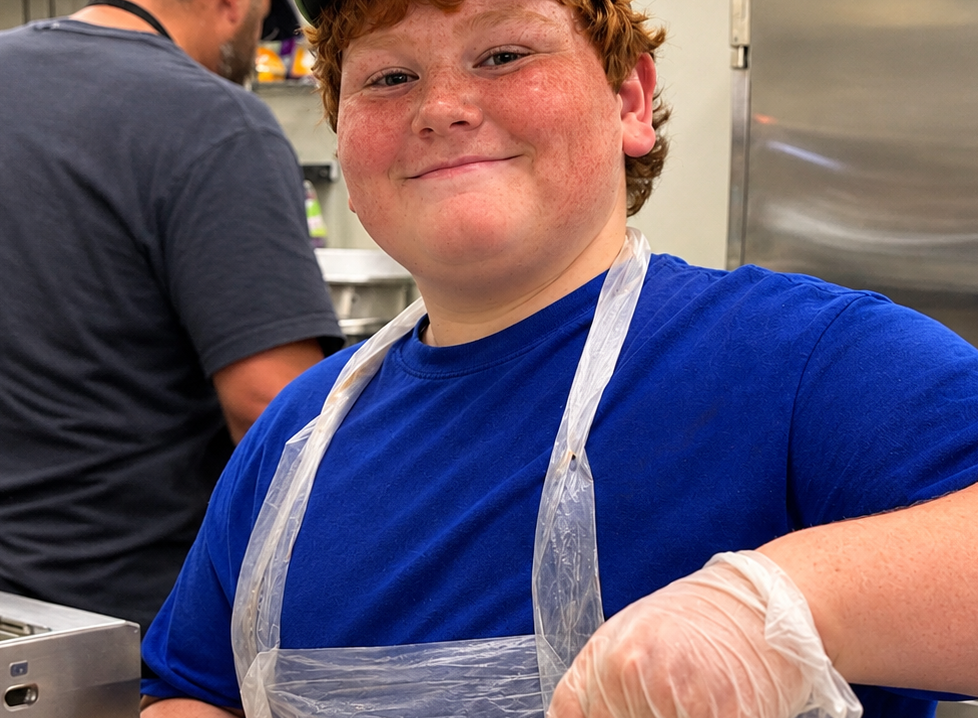
The community center was filled with volunteers setting tables and serving meals.
The smell of roast chicken and freshly baked bread filled the room.
Noah was absolutely delighted.
He helped arrange the napkins, welcomed guests, and proudly showed everyone the chocolate cake.
I stayed close to him, making sure he rested whenever he began to feel tired.
Throughout the afternoon, I noticed him repeatedly glancing toward the entrance.
“Are you waiting for someone?” I asked.
“Maybe,” he answered with a mysterious smile.
Late that afternoon, the coordinator came over with wonderful news.
“We’ve served 300 people!”
Noah’s face lit up.
“Exactly 300?”
“Exactly 300.”
He leaned against my shoulder.
“Did we do something good, Mom?”
“We did something wonderful, sweetheart.”
At that moment, a tall man wearing a dark suit and a long black coat entered the room.
He looked around before walking directly toward our table.
As soon as Noah saw him, his face went pale.
He held his backpack tightly against his chest.
“Clarice?” the stranger asked.
“Yes?”
“My name is Daniel. I’m afraid your son hasn’t told you the whole truth.”
My heart began beating much faster.
“What truth?”
Daniel glanced at Noah, who was nervously staring at his backpack.
“Do you remember a man who once shared his sandwich with you?”
Suddenly, a memory from four years earlier came rushing back.
It had been a freezing afternoon in the park.
We had very little money at the time.
I’d made Noah the last sandwich we had left at home.
There wasn’t enough food for both of us, so I told him I’d already eaten.
A stranger approached our bench.
He was wearing an old brown jacket.
He offered us half of his sandwich.
At first, I refused, but he placed it between us anyway.
“My name is Michael,” he said. “I volunteer at a community assistance center on the other side of town. I know how to recognize someone who’s hungry.”
Eventually, I accepted the sandwich.
Now, four years later, I was sitting across from a man who seemed to know about that afternoon.
“Michael?” I whispered.
Daniel nodded.
“He was my brother.”
Noah slowly opened his backpack and took out the small keepsake box.
Inside was an old paper napkin, carefully preserved in a clear plastic sleeve.
One corner had a faint brownish stain.
“Mom,” Noah whispered, “there’s something I never told you.”
I stared at the napkin.
“Do you remember that day in the park?”
I nodded, unable to speak.
“Michael wrapped the sandwich in this napkin. I kept it because I knew you hadn’t eaten anything that day. You looked so sad, and I didn’t want you to worry about me.”
My eyes filled with tears.
“Why didn’t you ever tell me?”
“You already had enough to worry about.”
Then he added softly:
“That’s why I chose this dinner. I remembered what Michael did for us. I wanted to do something similar for other people.”
Daniel explained that his brother had once experienced homelessness himself.
After finding stable housing, Michael continued volunteering at the community center, helping people facing the same hardships he’d experienced.
“He always believed that nobody should have to go hungry,” Daniel said.
Then he shared another heartbreaking detail.
“Michael passed away last year. When the coordinator told me about Noah’s wish, she arranged for us to meet. Noah wanted to honor my brother’s memory.”
I took my son’s hand.
Daniel then reached into his coat pocket and pulled out a handwritten recipe card.
“Michael used this recipe when he volunteered here. He loved making sandwiches for people who needed help.”
Noah carefully examined the card.
“Does it have mustard in it?”
Daniel laughed.
“Michael hated mustard.”
“Good. He had excellent taste,” Noah replied.
For the first time that afternoon, we all laughed through our tears.
Daniel looked around the dining room and smiled.
“I think Michael would have loved what happened here today.”
Noah glanced down at his empty plate.
“Even the dessert?”
“Especially the dessert,” Daniel answered.
A few weeks later, Noah returned to the hospital for another medical appointment.
When we finally got home, he asked me to make sandwiches using Michael’s recipe.
He took one bite and made a face.
“It’s too chewy.”
“Then stop eating it,” I joked.
“I’m reviewing it, Mom.”
I made another sandwich, placed it in an airtight container, and put it in the refrigerator.
“Who’s that for?” Noah asked.
“For the assistance center, if they accept this kind of donation. We’ll check what they need first.”
He nodded thoughtfully.
“Can we make more next time?”
“Of course, sweetheart.”
He looked at the container and smiled.
“Michael only gave us half a sandwich, but that day, it was enough.”
I held him tightly in my arms.
That afternoon, I understood that kindness doesn’t have to be grand or expensive.
Sometimes it begins simply by sharing half a sandwich with someone who’s hungry.
Sometimes that small gesture stays in a child’s heart for years and inspires them to feed 300 strangers.
Noah had been given the chance to make one wish during the most difficult battle of his young life.
He could have asked for almost anything.
Instead, he chose to give something to others.
And in doing so, he reminded us all that even the smallest act of kindness can continue to live on long after the person who started it is gone.