
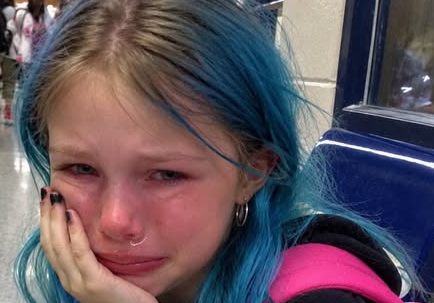
My daughter was humiliated because of her blue hair, but what she did next made the entire school rethink its actions.
Lily pointed directly at Mrs. Collins.
“You made me believe that monsters look like me.”
Mrs. Collins brought a hand to her mouth.
“No, Lily. I never said anything like that.”
My daughter’s voice was trembling.
“But you didn’t stop the people who did.”
A heavy silence filled the room.
The school principal, Mr. Hayes, was holding a folded sheet of paper.
At the top, written in large black letters, were the words:
“THINGS PEOPLE SAID TO ME YESTERDAY.”
Below was a list:
Witch.
Monster.
Weird.
Ugly.
And at the very bottom:
Mrs. Collins: “Your appearance is becoming a distraction.”
I froze.
“Where did you get that?” I asked.
“I wrote it myself,” Lily replied.
That was when I noticed her shirt.
Underneath her denim jacket, my daughter was wearing a T-shirt with every insult she had heard the previous day written across the front.
On the back, in much larger letters, was a question:
“IF THESE WORDS ARE SO DISTRACTING, WHY DIDN’T YOU PUNISH THE PEOPLE WHO SAID THEM?”
My name is Rachel, and Lily is my only child.
At that moment, I didn’t know whether to feel proud, angry, or terrified.
Probably all three at once.
I crouched beside my daughter.
“Are you okay?”
She nodded, but I knew that didn’t necessarily mean everything was truly fine.
“Did anyone hurt you?”
“No.”
“Did you get into trouble?”
Lily glanced at Mrs. Collins.
“She told me to put my jacket back on.”
The teacher quickly explained that the words written on Lily’s shirt had been disturbing the other students.
I looked her straight in the eyes.
“Yesterday, those exact same words weren’t serious enough for you to remove the children who were saying them from the classroom. But today, when Lily writes them on her shirt, they suddenly become inappropriate?”
Mrs. Collins lowered her gaze.
“I handled yesterday’s situation badly.”
Her answer surprised me.
She explained that she had believed removing Lily from the classroom would calm everyone down.
“You removed the child who was being bullied,” I said.
“I know.”
“And you told her that her appearance was a distraction.”
“I know.”
At that moment, Mrs. Collins crouched in front of Lily.
“I made a mistake. When the other children started making comments about your hair, I should have stopped them.”
Lily stared at the floor.
“Tyler said, ‘See? Even Mrs. Collins thinks you’re ugly.'”
The teacher looked genuinely shaken.
“I didn’t know he said that.”
“Because you never asked me,” Lily whispered.
Nobody said a word.
I turned toward the principal.
“Why was Lily sent to your office yesterday?”
Mr. Hayes explained that Mrs. Collins had sent her there because she believed Lily had disrupted the lesson.
I asked whether my daughter had broken any school rules.
“No,” he admitted.
“Then why was she the one who had to explain herself? My daughter’s appearance is not a classroom disruption.”
The principal nodded.
“You’re right.”
That was when Lily told us exactly what had happened.
She had entered the classroom with her jacket zipped all the way up to her neck.
Tyler, the same boy who had called her a witch the previous day, whispered something to another student.
A few children started laughing.
Later, when Mrs. Collins asked everyone to remove their jackets because the classroom was warm, Lily asked whether she really had to.
When she finally took off her jacket, everyone saw her shirt.
Mrs. Collins immediately told her to cover the writing.
Lily then pulled a sheet of paper from her sleeve and said:
“Yesterday, these words didn’t bother anyone.”
She hadn’t shouted.
She hadn’t argued.
She hadn’t tried to cause a scene.
She was simply an eight-year-old girl standing in front of her classmates, showing everyone the insults the adults had failed to protect her from.
I asked Lily why she hadn’t told me about the shirt beforehand.
“Because you were already angry,” she answered.
“At you?”
“No. At them.”
I wrapped my arms tightly around her.
Then I asked why she had painted her nails black again, even after the other children had told her they looked horrible.
“Because they said they were ugly,” she replied.
That answer hurt more than anything else.
My daughter wasn’t simply trying to express her personality.
She was trying not to let other children decide who she was allowed to be.
The principal explained that four students had repeatedly made hurtful comments about Lily’s appearance.
Their parents had already been contacted.
The school had also arranged meetings supervised by the school counselor to discuss what had happened and help repair the harm.
Tyler had been moved to another desk, away from Lily.
The entire class would also attend a lesson about bullying, teasing, and judging people based on their appearance.
I worried that all of this would make my daughter feel even more uncomfortable.
“I just want everyone to stop staring at me,” Lily said.
Fortunately, the school counselor handled the situation with great sensitivity.
She didn’t ask Lily to stand in front of the entire class.
She didn’t turn my daughter into an example for everyone else.
Instead, she wrote two sentences on the board:
“Someone is different.”
“Someone makes fun of that difference.”
Then she asked the students which behavior was the actual problem.
Most of the children understood immediately.
Tyler, however, protested.
He said that if Lily hadn’t had blue hair, nobody would have made fun of her.
The counselor looked at him and asked:
“If I made fun of you because you wear glasses, would the problem be your eyes or my behavior?”
Tyler fell silent.
That afternoon, Lily told me that the school counselor was “really scary.”
I burst out laughing.
A few days later, Mrs. Collins called me.
She apologized again and admitted that she had formed an opinion about Lily before anything had even happened.
She had grown up believing that brightly colored hair was a sign of rebellion and that black nail polish meant trouble.
“I projected my adult prejudices onto an eight-year-old child,” she said.
“Yes,” I replied.
“And then I punished her for causing a reaction I had already expected.”
I appreciated the fact that she wasn’t trying to make excuses.
The following morning, Lily asked whether she could wear that shirt again.
I told her no.
“You’ve already made your point,” I explained. “And I don’t want you walking around school with the word ‘ugly’ written across your chest.”
She thought about it for a moment.
“Can I wear my jacket?”
“Of course.”
“And can I keep my nails black?”
“Of course.”
“And can my hair stay blue?”
“Absolutely! It’s part of who you are!”
Lily smiled.
When we arrived at school, Tyler and his mother were waiting near the principal’s office.
The woman introduced herself and apologized for her son’s behavior.
Tyler stared at the floor.
His mother encouraged him to apologize to Lily properly.
“I’m sorry I called you a witch and a monster,” he mumbled.
Lily crossed her arms.
“Okay,” she replied.
She didn’t say she forgave him.
She didn’t say everything was forgotten.
She simply answered:
“Okay.”
Then she asked him to apologize for calling her blue hair ridiculous.
Tyler did.
Over the following weeks, something happened that I hadn’t expected at all.
The other children began feeling more comfortable expressing their individuality.
One little girl started wearing the glasses she had previously tried to hide.
A boy came to school wearing pink shoelaces.
Another girl stopped covering the birthmark on her arm.
I didn’t want Lily’s experience to become another story about a brave little girl who taught everyone to love themselves.
After all, my daughter was only eight years old.
She simply liked the color blue.
But children pay very close attention to what adults allow and tolerate.
Once the school made it clear that being different wasn’t something wrong, some students began feeling much more comfortable being themselves.
Mrs. Collins changed, too.
A month later, the class organized a day dedicated to everyone’s favorite colors.
Naturally, Lily arrived dressed in blue.
Mrs. Collins, meanwhile, showed up with a purple streak in her hair, created with temporary hair dye.
That afternoon, Lily came home looking completely shocked.
“Mom! Mrs. Collins dyed her hair!”
“And what’s wrong with purple?” I asked.
“It doesn’t suit her at all!”
I smiled.
“So now we’re the ones judging other people’s hair?”
Lily rolled her eyes.
“You’re so annoying!”
“Exactly,” I replied.
Eventually, she admitted that Mrs. Collins did have her own sense of style.
I kept Lily’s shirt in a box alongside her school photographs and birthday cards.
Over time, the writing faded a little.
But the question on the back is still perfectly readable:
“IF THESE WORDS ARE SO DISTRACTING, WHY DIDN’T YOU PUNISH THE PEOPLE WHO SAID THEM?”
I’ve thought about that question countless times.
That day, I walked into the school expecting to find someone to blame for my daughter’s suffering.
Instead, I found a teacher who had made a poor decision because of her own prejudices.
A principal who initially hadn’t recognized the real problem.
And children who were learning that treating others with cruelty was unacceptable.
Mrs. Collins never became Lily’s favorite teacher.
But over time, my daughter learned to trust her again.
And that meant a great deal.
Because the real problem had never been the blue hair.
It wasn’t simply the incident that had taken place at school that day, either.
The real problem was that my daughter had started believing she needed to change her appearance to make other people feel comfortable around her.
But instead of changing herself, she chose a different path.
She gathered every hurtful word that had been directed at her.
She displayed those words for everyone to see.
And she made the adults reflect on one essential question:
Was blue hair really what was distracting students during class?
Or was the real problem the cruelty directed at an eight-year-old girl who simply wanted to be herself?