
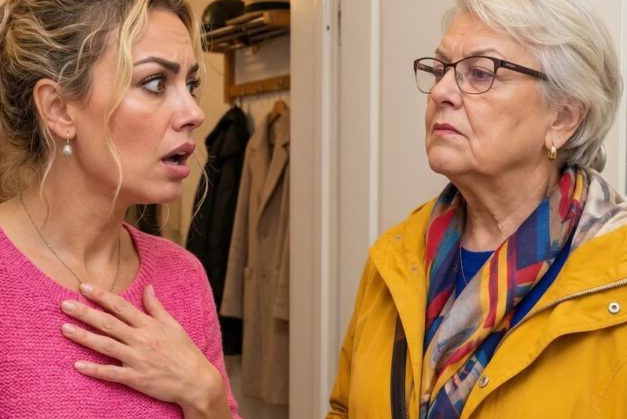
My husband had secretly given his mother a key to our front door. But when I discovered what the two of them had planned for our house, I could hardly believe what I was hearing.
My mother-in-law’s name was Renata. She stood in the middle of our hallway, with two enormous rolling suitcases beside her. There was such confidence on her face that you’d think she’d just been given the right to make every decision about our home.
I looked at my husband.
“Thomas, would you mind explaining why your mother is standing in our hallway with two huge suitcases?”
He lowered his eyes.
“Katarina, please, don’t get upset right away.”
Renata took a silver-colored key out of her handbag and placed it on the small wooden cabinet by the door.
“Thomas gave me my own house key. Now I won’t have to ring the doorbell anymore.”
I stared at the key.
“You gave your mother a key without even asking me?”
“It’s just a key,” Thomas muttered.
But I already knew that the problem wasn’t simply the key.
I was fifty-four years old, and Thomas and I had been married for twenty-seven years.
We lived in a small house on the outskirts of Hanover. Our two children were already grown. Laura worked in Hamburg, and Jonas was studying in Göttingen.
I worked as an administrator at a medical clinic, while Thomas was a warehouse manager.
We’d bought the house twenty-five years earlier and had paid the mortgage together.
When Thomas lost his job, I took extra shifts. When the roof needed repairs, I used part of my inheritance to pay for them.
That house represented decades of our work together.
But Renata apparently believed her son had the right to decide what happened to our home all by himself.
“And where exactly are you planning to sleep?” I asked her.
“In the large room overlooking the garden.”
“That’s my sewing room.”
“Then move your things down to the basement.”
I looked at Thomas.
“You promised her my room?”
He said nothing.
“Thomas?”
“Mom needs some space.”
Renata smiled with satisfaction.
“See, Katarina? At least my son understands what family means.”
I felt my face grow hot.
“Renata, you’re not moving in here today.”
Her smile vanished.
“How dare you?”
Before I could answer, my phone rang.
It was our daughter, Laura.
“Mom, has Grandma arrived yet?”
I stepped into the kitchen.
“How do you know about this?”
“Dad told me two weeks ago.”
My fingers tightened around the edge of the countertop.
“Two weeks ago?”
“Yes. And Grandma called me yesterday. She wanted me to convince you to sign some documents related to the house.”
A chill ran through me.
“What documents?”
“She mentioned a notary. She said Dad’s interests needed to be protected.”
I thanked Laura and went back to the hallway.
Thomas was just lifting one of the suitcases.
“Put it down.”
He looked at me in surprise.
“What’s wrong now?”
“I want to know why your mother called our daughter and asked her to convince me to sign documents concerning our house.”
Renata’s expression froze.
Thomas went pale.
After a moment, he took an envelope from his pocket.
The name of a notary’s office in Hanover was printed on it.
I opened it.
Inside was a consultation confirmation. Thomas had previously asked about ways to protect our assets and plan our inheritance arrangements.
There was also a reference to the possibility of transferring an ownership share.
I read the letter twice.
“Why did you arrange an appointment with a notary about our house without telling me?”
Thomas cleared his throat.
“Mom said we should get everything organized in advance.”
“Organize what?”
Renata answered for him.
“My son has worked hard. He deserves to know the house will remain his.”
I stared at her in disbelief.
“What about me? Do you think I haven’t put any work or money into this house?”
She shrugged.
“Thomas has always made the important decisions.”
I almost wanted to laugh.
Eleven years earlier, when Thomas lost his job, it was my salary that kept our bills paid.
When we needed a new heating system, I used my savings.
And now they wanted to exclude me from decisions about our own home.
“Renata,” I said, “you can take your suitcases back to the car.”
“Thomas!” she exclaimed indignantly.
My husband stood motionless.
“Katarina, Mom has already sold her house.”
I froze.
“What?”
Renata lifted her chin.
“The agreement was finalized last week. The sale documents have already been signed.”
I looked at Thomas.
“You knew?”
He nodded.
“And you didn’t tell me anything?”
“I wanted to explain everything.”
“When? After your mother was already sleeping in my sewing room?”
Nobody answered.
I sat down on the bottom step of the staircase.
Only then did I fully understand that this hadn’t been a sudden decision.
They’d been planning everything for weeks.
And I was the only person who knew absolutely nothing.
Renata crossed her arms.
“I’m seventy-three years old. Since Robert died, I’ve been alone. Am I really supposed to live without my family at my age?”
Her voice trembled slightly.
I knew how much she missed her husband.
Robert had died eight months earlier after a long illness.
But her grief didn’t give her the right to change my life without my consent.
“I would have helped you, Renata,” I said. “We could have found a solution together.”
“I don’t need solutions from outsiders. My son promised me I could live here.”
I turned to Thomas.
“So you promised her something you had no right to decide on your own.”
That evening, Renata took her suitcases and left. Thomas drove her home.
When he returned, I was sitting at the kitchen table.
Our old mortgage documents and bills lay in front of me.
“We need to talk,” he said.
He sat down across from me.
“I know.”
“No, Thomas. I don’t think you understand how badly you’ve hurt me.”
He remained silent.
“You gave your mother a key. You promised her my room. You talked with her about our house and consulted a notary. Why?”
He rubbed his forehead.
“Since Dad died, Mom calls almost every evening. She cries and says she can’t manage on her own. And whenever I suggest something else, she says I’m abandoning her.”
“So you decided to abandon me instead?”
He raised his head.
Those words clearly hurt him.
“I hadn’t thought of it that way.”
“But that’s exactly what you did.”
We sat in silence for a long time.
Finally, he said:
“I’m sorry.”
I wanted to believe him.
But after twenty-seven years of marriage, I knew one apology wasn’t enough.
The following morning, I called the notary’s office.
The employee explained that she couldn’t disclose information about my husband’s confidential discussions without the necessary authorization.
So I asked Thomas to schedule a consultation together.
He agreed.
A week later, we were sitting across from the notary.
Thomas expressly agreed to have his earlier questions discussed in my presence.
It turned out that no transfer of our house had yet been prepared or carried out.
The consultation had simply been intended to clarify inheritance and ownership arrangements.
The notary explained that an actual change in ownership rights would require additional legal steps and the involvement of all relevant owners.
I felt relieved.
But my trust in Thomas had already been seriously damaged.
In the parking lot, I asked:
“Why didn’t you simply talk to me?”
He looked at the ground.
“Because I knew you wouldn’t agree.”
“Then you should have respected my decision.”
He nodded.
“You’re right.”
Two days later, Laura called me again.
“Mom, I think there’s something you should know.”
I immediately sensed that it was important.
“What is it?”
“Grandma told me she wants to give Uncle Stefan most of the money from selling her house.”
Stefan was Thomas’s younger brother.
He lived in Munich and had experienced several financial difficulties in recent years.
“How much?” I asked.
“Seventy-five thousand euros.”
I fell silent.
Renata had sold her house, intended to give a substantial amount of the money to her younger son, and at the same time expected to move in with us.
Suddenly, a lot of things looked very different.
When Thomas came home that evening, I told him about the conversation.
He stared at me in disbelief.
“Mom never said anything to me about that.”
He called her immediately.
Renata confirmed the amount.
“Stefan needs help,” she explained.
“Mom, seventy-five thousand euros is a huge amount of money.”
“It’s my money.”
“Of course it is. But what will you live on afterward?”
“I have my pension.”
“And what happens if you need additional help someday?”
She raised her voice.
“That’s exactly why I have children!”
Thomas looked at me.
I think that was the first time he truly understood how much responsibility he’d taken on by making decisions without consulting me.
We talked for a long time that evening.
And not just about Renata.
We talked about our marriage.
About how often Thomas had given in to his mother simply to avoid conflict.
About family celebrations where I’d endured her comments.
And about decisions he made as a son, even when they affected both of us.
Finally, I said:
“I’m not going to let us give up our own lives simply because you can’t tell your mother no.”
Thomas nodded.
“What do you suggest?”
“We’ll help her find a suitable place to live. But she’s not moving into our house against my wishes.”
The following Saturday, we invited Renata over for a conversation.
She arrived carrying a red handbag, with a cautious expression on her face.
“I hope you’ve both calmed down,” she said.
Thomas asked her to sit.
“Mom, we need to talk about your future.”
She immediately looked at me.
“This is another one of Katarina’s ideas.”
“No,” Thomas replied. “I promised you something without discussing it with my wife first. That was wrong.”
Renata stared at him.
“You gave me your word.”
“Yes. And I shouldn’t have done that.”
Her eyes filled with tears.
“So you don’t need me anymore?”
Thomas moved closer to her.
“I do need you, Mom. You’re important to me. But Katarina is my wife, and this house is part of the life we’ve built together.”
Renata wiped her eyes.
“I just don’t want to be alone.”
For the first time, her voice didn’t sound commanding.
She sounded helpless.
I sat down beside her.
“Renata, nobody wants you to be alone. But there are other options.”
She shook her head.
“Like what?”
“A small apartment near us. Or a residential community for older adults where you can meet other people.”
“I don’t need a nursing home!”
“I’m not talking about a nursing home. You can live independently and still have people around you.”
Thomas showed her several apartment listings.
At first, she didn’t want to look at any of them.
But then a bright two-room apartment in a senior living complex caught her attention.
It was in Langenhagen, not far from us.
There was a shared lounge, regular social activities, and a small garden nearby.
“That doesn’t look too bad,” she muttered.
We arranged a viewing.
Meanwhile, Renata spoke with an independent financial adviser about her income, savings, and future expenses.
She decided not to give Stefan the seventy-five thousand euros for the time being.
Stefan was disappointed.
But this time, Renata didn’t change her mind.
Two weeks later, we went together to see the apartment.
It was bright and welcoming. The living room overlooked a small inner courtyard.
Renata walked slowly through every room.
She stopped in the kitchen.
“Robert would have liked it here,” she said suddenly.
I looked at her.
Her eyes filled with tears.
“A few years ago, he wanted us to move somewhere smaller. I always told him we were still strong enough to stay in our house.”
She ran her hand along the windowsill.
“And then suddenly he was gone.”
I said nothing.
She turned toward me.
“You know, Katarina, I was so afraid that after he died, nobody would need me anymore.”
“We do need you.”
“But I wanted to be sure. So I thought that if I simply moved in with you, nobody would ever be able to leave me alone again.”
I gently took her hand.
“You can be part of our family without making decisions about our lives.”
She nodded.
A month later, Renata moved into her new apartment.
The sale of her house was completed, and she kept enough money for daily expenses and a financial reserve.
Thomas helped her move.
I sewed a curtain for her living room.
She thanked me quietly.
From that point on, our family life gradually began to change.
Renata still came to visit us on Sundays.
She still had her own ideas about how a household should be run.
Sometimes she criticized my cooking or the decorations.
But now she asked before changing anything.
And increasingly, she accepted that I might have an opinion different from hers.
Thomas and I started seeing a family therapist.
It wasn’t easy.
We had to discuss things we’d avoided talking about for years.
But gradually Thomas learned to set boundaries without feeling guilty.
And I learned to express my needs before disappointment turned into resentment.
One Sunday, Renata came over for coffee.
After the meal, she stopped outside my sewing room.
“May I come in?”
I smiled.
“Of course.”
On my table lay an almost-finished patchwork quilt.
Renata examined it carefully.
Then she gently touched a piece of blue fabric.
“Is this one of Robert’s old shirts?”
I nodded.
“You gave me some of his clothes. I thought I could make something for you with them.”
She slowly sat down.
“For me?”
“Yes.”
I spread out the quilt.
Among the colorful pieces of fabric were sections cut from Robert’s old shirts.
Renata ran her fingers over the cloth.
Then she began to cry.
“I miss him so much,” she whispered.
I sat beside her.
We remained silent for a long time.
Finally, she looked at me.
“Katarina, I behaved terribly that day.”
I said nothing.
“I shouldn’t have simply shown up with my suitcases. And I never should have told you how to live in your own home.”
For the first time in twenty-seven years, Renata sincerely apologized to me.
“Thank you,” I said.
She hugged the quilt tightly against her chest.
“Can I really keep it?”
“Of course. It’s yours.”
When Renata left for home that evening, Thomas walked her to the car.
I stayed in the hallway.
My eyes fell on the small wooden cabinet beside the entrance.
That was where the silver-colored key had once been placed.
The same key Thomas had secretly given his mother.
Now the only keys on the cabinet were our shared set.
Thomas came back inside and took my hand.
“Thank you for giving Mom another chance,” he said.
I looked at him.
“I never closed the door to our family on her. I simply didn’t want her making decisions about our home without my consent.”
He squeezed my hand.
And then I understood something I should have learned much earlier.
Peace in a family doesn’t mean constantly giving in.
Sometimes true peace only begins when someone finally has the courage to say “no.”
Because love should never require a person to surrender their dignity just so someone else can always have everything their own way.