
The Little Girl on Top of the Wardrobe
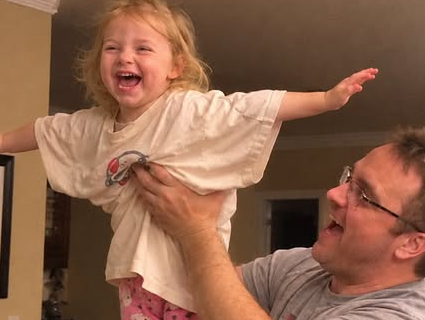
I was playing airplane with my three-year-old daughter, Ellie, when she suddenly started screaming.
“Daddy, put me down! RIGHT NOW!”
I immediately lowered her to the floor.
“There’s a little girl up there!” she cried, pointing toward the enormous wardrobe in our living room.
I couldn’t see anything, but Ellie was terrified.
I grabbed a chair and climbed onto it to check. What I discovered nearly made me fall backward.
Every evening, Ellie and I played airplane. I lifted her high above my head while she stretched out her arms and pretended to fly.
That evening, my wife, Anna, was working late, and Ellie had begged me for one last flight.
We went down the hallway and into the living room. But as we passed the wardrobe, her laughter suddenly stopped.
“Daddy, down!”
She was pointing toward the top of the wardrobe.
“The girl! She’s looking at me!”
I climbed onto a chair and looked over the top of the wardrobe. A pair of eyes stared back at me. I nearly lost my balance before realizing they belonged to a little girl in an old photograph.
The picture showed a young girl with curly brown hair wearing a yellow dress. She looked almost exactly like Ellie, right down to a small crescent-shaped birthmark above her left eyebrow.
Behind the photograph, I discovered a dusty bundle containing a yellow dress, a stuffed rabbit, and an envelope addressed to Anna.
Three words and a date were written on the back of the photograph:
“Our beautiful Lucy. June 1994.”
I carried everything downstairs.
“Did the little girl go away?” Ellie asked.
“She’s only in a photograph, sweetheart.”
When she saw the picture, she placed her finger against the glass.
“That’s me.”
“No, honey. That’s another little girl.”
“Then why does she have the same face as me?”
I didn’t know what to say.
Later that evening, Anna came home. The moment I showed her the photograph, her face turned pale.
“Where did you find that?”
“On top of your mother’s wardrobe. Who is this little girl?”
Anna’s eyes filled with tears.
“That’s Lucy. My little sister.”
I was stunned. We had been married for eight years, and she had never mentioned having a sister.
“She died when we were little,” Anna whispered. “I was nine. She was four.”
Anna explained that they had been playing at home when Lucy fell down the basement stairs. Anna had been asked to look after her younger sister, and she had never forgiven herself for leaving her alone.
“I was supposed to protect her,” she said.
I tried to comfort her, but she didn’t want to talk about it anymore.
The following morning, Ellie asked about the photograph.
“Mommy, that little girl looks like me.”
“Her name was Lucy,” Anna replied. “She was my sister.”
“Where is she?”
“She died a very long time ago, sweetheart.”
Ellie gently hugged her.
After Ellie left for preschool, I brought the old bundle into the kitchen.
Anna immediately recognized all the objects.
“My mother must have kept her things,” she said.
I showed her the envelope. She recognized her mother’s handwriting, but she had never seen the letter before.
She slowly opened it.
The letter began:
“My dearest Anna,
There is something I should have told you a very long time ago.”
Anna began reading aloud.
Her mother explained that Anna had been only nine when Lucy died. She admitted that she had unfairly placed the responsibility of watching her little sister on Anna, even though Anna was still a child herself.
Then came the words that changed everything.
“After the accident, I said things at the hospital that you should never have heard. I was frightened and angry, and I needed someone to blame.”
Anna began to cry.
The letter continued:
“The basement door had been faulty for several weeks. The latch was loose, and I knew it needed repairing. That afternoon, I believed the door was properly closed, but it wasn’t.
You were never responsible for protecting your sister from a danger I knew existed.
I failed to protect Lucy. And afterward, I failed to protect you by allowing you to believe that her death was your fault.”
Anna covered her mouth with her hand.
For more than thirty years, she had lived believing she was responsible for her sister’s death.
Her mother was finally admitting the truth: Anna had been only a child, and that responsibility should never have been placed on her shoulders.
The final lines read:
“That day, you lost your sister. You should not have lost your childhood to guilt as well.
Please forgive yourself for something that was never your responsibility.
I love you. Mom.”
Anna pressed the letter against her chest and broke down in tears.
“She knew I’d been blaming myself all these years,” she whispered.
I wrapped my arms around her. The letter couldn’t change what had happened, but it finally gave Anna permission to stop punishing herself.
Over the following weeks, she began sharing memories of Lucy and showing me photographs of her sister. She even made an appointment with a psychologist to help her work through the guilt she had carried for so long.
One evening, Ellie noticed the photograph standing on our bookshelf.
“Mommy, it’s the little girl!”
Anna smiled.
“Yes, sweetheart. That’s Aunt Lucy.”
“Did she like airplanes?”
Anna laughed softly.
“She loved pretending to fly.”
Ellie turned toward me excitedly.
“Daddy, can we fly?”
I looked at Anna.
“Permission for takeoff?”
She smiled through her tears.
“Just be careful with your back.”
I lifted Ellie above my head, and she stretched out her arms.
“To the Moon!”
As we passed the bookshelf, Ellie waved at the photograph.
“Bye, Aunt Lucy!”
Anna watched us with tears in her eyes, but this time she was smiling.
That evening, she curled up beside me and whispered:
“I spent so many years trying not to remember her.”
“You don’t have to hide those memories anymore,” I replied.
For a long time, I thought I had simply discovered something frightening on top of an old wardrobe.
In reality, I had uncovered a family secret that had haunted my wife for almost her entire life.
We couldn’t change what had happened to Lucy, but Anna could finally remember her sister without believing she was responsible for her death.
And she no longer had to carry that pain alone.