
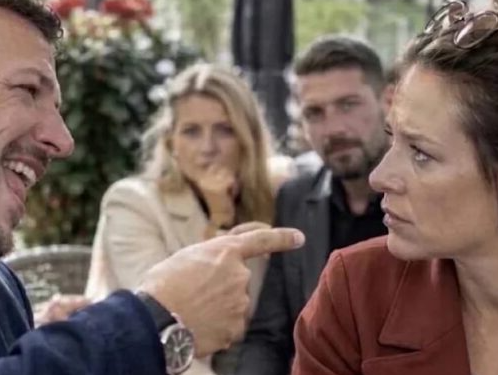
“Then I’ll move in with my mother until you finally come to your senses!” Martin announced loudly, bursting into such a booming laugh that people at the neighboring table turned to look.
He was holding a mug of beer.
We were sitting with six friends on the summer terrace of a restaurant in Stortorget Square, Malmö.
Someone gave an awkward smile, while the others suddenly began studying their menus with remarkable interest.
I stared at the fork beside my plate.
“Fine,” I answered quietly.
Martin’s smile grew even wider.
“Did you hear that? She’s finally starting to understand!”
Our friend Johan tried to ease the tension.
“Come on, that’s enough. We got together to enjoy a pleasant evening, not to hold a family meeting.”
But Martin had no intention of stopping.
“No, let everyone hear this! Dorothea thinks absolutely every decision in a marriage has to be made together. Even how long my own mother can live in our house.”
I looked up.
“It’s not about how long she can stay as a guest. It’s about the fact that you gave her keys and agreed to let her move in without even asking for my opinion.”
Martin waved his hand dismissively.
“She’s my mother, not some stranger.”
“And who am I?”
He was silent for a moment before shrugging.
“My wife. But sometimes you seem to forget what that actually means.”
I put down my fork.
I didn’t raise my voice, burst into tears, or try to continue the argument.
I simply took out my phone and checked the time.
It was 8:12 p.m.
Martin noticed.
“What are you doing?”
“Checking when my bus leaves.”
“Why?”
“I’m going home.”
“Great. Maybe you’ll finally spend some time thinking about your behavior.”
I stood up, said goodbye to our friends, and headed toward the exit.
Behind me, I heard his voice:
“And don’t even think about calling me in the middle of the night and begging me to come back! I mean it this time!”
I didn’t even turn around.
Martin didn’t know that three days earlier, I had discovered something he’d been carefully hiding from me.
And that evening, I decided I was done pretending I hadn’t noticed anything.
My name is Dorothea Lind. I’m thirty-eight years old, and I work as an economist for a construction company in Malmö.
I met Martin eleven years ago at a mutual friend’s birthday party.
At the time, he was the manager of an auto parts store.
He was confident, funny, and had a way of instantly drawing everyone’s attention.
I liked that he always seemed to know exactly what to say.
It took me years to understand that self-confidence and believing you’re never wrong are two entirely different things.
We got married six years ago.
During the first few years, we rented an apartment in Limhamn, worked long hours, saved money, and dreamed of owning a home.
Everything changed after my aunt Helena passed away.
She had no children, and I’d visited her regularly since my university days.
During the final years of her life, I helped with grocery shopping, accompanied her to medical appointments, and took care of everyday tasks.
In her will, my aunt left me a small house with a garden.
It stood on a quiet street on the outskirts of Malmö.
It had two bedrooms, a living room, a kitchen, a bathroom, and a small home office.
It wasn’t a luxurious property, but it meant a great deal to me.
At first, Martin was delighted.
Or at least that was what I thought.
Before moving in, we paid together for the bathroom renovation and some electrical work.
We kept every receipt and carefully accounted for our expenses.
The house remained my personal property.
My aunt had specifically stated that in her will.
Even so, I never treated Martin like a guest.
We paid the bills together, bought furniture, and took care of the garden.
For a long time, everything went well.
The problems began when his mother, Birgitta, started visiting us more and more often.
She was sixty-eight and lived alone in her own apartment in Arlöv.
Two years earlier, she’d sold her large terraced house because maintaining it had become increasingly difficult.
Instead, she bought a comfortable apartment in a building with an elevator, close to a grocery store and a medical clinic.
But even there, she always found something to complain about.
Sometimes the neighbors were too noisy. Other times the apartment fees seemed too high. And on other occasions, she complained that her balcony was in the shade during the afternoon.
Whenever she visited, she often remarked:
“You’re so lucky! Just the two of you, and all this extra space.”
One Sunday over lunch, she glanced toward the guest bedroom and observed:
“I could live very comfortably here.”
Martin laughed.
“Mom, there will always be room for you in our house.”
I took it as a simple expression of politeness.
But a few months later, Birgitta was already thinking about what curtains she’d like to hang in the guest bedroom.
Then she asked whether we could remove my bookcase.
And one Saturday morning, Martin announced:
“Mom is moving in with us this fall.”
He didn’t ask for my opinion.
He simply presented it as a decision that had already been made.
“When did we agree to that?” I asked.
“We’re agreeing to it right now.”
“No. You’ve already decided for both of us.”
He sighed heavily.
“Dorothea, don’t start again. Mom is lonely.”
“She has her own apartment.”
“So what? She’s still alone.”
“We can visit her more often, help her find activities, and invite her over. But you can’t decide who gets to live in our home without discussing it with me.”
Martin’s expression hardened.
“Here you go again with that ‘your house’ business!”
“That’s not what this is about.”
“That’s exactly what it’s about! You keep reminding me that everything is in your name.”
That was unfair.
I’d never used my inheritance to humiliate my husband.
But I wasn’t going to pretend that he could make decisions on his own about a property he didn’t own.
After that conversation, almost every argument ended the same way.
Meanwhile, Birgitta increasingly behaved as if she’d already moved in.
One Tuesday evening, I came home late from work and found three large suitcases outside the guest bedroom.
“Whose things are these?”
Martin was sitting in front of the television.
“Mom’s. She brought over some of her belongings.”
“What for?”
“Because she’ll be moving in soon.”
“Martin, I never agreed to that.”
“You’ll get used to it.”
The next morning, I found a locksmith’s receipt on the kitchen counter.
Four hundred kronor.
When I asked who the extra key had been made for, my husband replied:
“For Mom, obviously. You can’t expect her to ring the doorbell every time!”
That was the first time I felt that this was no longer an ordinary family disagreement.
Step by step, someone was trying to take away my right to make decisions in my own home.
But the most disturbing thing happened three days before the dinner with our friends.
I was sitting at work when an unfamiliar woman called me.
She introduced herself and asked:
“Good morning, Dorothea. I’m calling about the room you’re renting out in your house. Would it be possible to see it on Saturday?”
At first, I thought she had the wrong number.
“What room?”
The woman gave me our address.
Our exact address.
Then she explained:
“The listing says that part of the house, with a separate entrance from the garden, will be available in October.”
But there was no separate apartment in our house.
There was only a guest room with a window overlooking the garden.
“Who posted the listing?” I asked.
“Martin. He said he’d discussed everything with his wife.”
“Are you sure?”
“Yes. He assured me that the property owner had given her permission.”
I said nothing to my husband that evening.
First, I wanted to find out exactly what he was planning.
The following day, the woman sent me a screenshot of the advertisement.
It showed photographs of our garden.
The guest room.
Even the old walnut tree beside the terrace, which had stood there since Aunt Helena was alive.
The monthly rent was listed as 6,500 Swedish kronor.
The advertisement also stated that the space would be adapted for long-term rental.
At the bottom was a sentence:
“The rental is being arranged with the property owner’s consent.”
I stared at the screen, finding it increasingly difficult to breathe.
I had never approved any of this!
That same day, I contacted a lawyer I knew through work.
I told her about the advertisement and Martin’s plans.
She advised me to preserve our correspondence, the photographs, and any other evidence. She also recommended clarifying the legal rules concerning our shared residence.
Before ending the call, she asked:
“Does your husband know you found the advertisement?”
“No.”
“Then think carefully about how you approach the subject. Even if the house is your separate property, that doesn’t automatically mean you can simply deny your husband access to the home you share. There are legal procedures that must be followed.”
I thanked her.
I planned to speak to Martin on Friday evening.
But he had other plans.
He decided to teach me a lesson in front of our friends.
And when he laughingly announced over dinner that he was moving in with his mother until I learned how to behave, something inside me finally broke.
Why had Martin secretly advertised our guest room for rent? And what was he hiding from his own mother?
The continuation is in the first comment.
After dinner, I didn’t go straight home.
I got off the bus in the city center and called Birgitta.
“Good evening. Martin told me he’s planning to stay with you for a while.”
I could hear the satisfaction in her voice.
“Yes. He’s finally realized that it’s for the best.”
“So you already know?”
“Of course. I’ve even prepared a room for him.”
“Do you also know that Martin has advertised our guest room for rent?”
Silence fell on the other end of the line.
After a few seconds, Birgitta asked cautiously:
“What rental are you talking about?”
I told her about the advertisement.
Her reply took me completely by surprise.
“Dorothea, I thought Martin had discussed everything with you.”
“He hasn’t discussed any of it with me.”
“But he said you needed the money.”
I stopped in the middle of the sidewalk.
“What money?”
Birgitta sighed.
“You should talk to him about that.”
“Please tell me.”
She hesitated for a long time before finally explaining:
“Martin told me you were having financial problems. That you had large debts left over from the renovation.”
For a moment, everything seemed to go dark.
We didn’t have a joint mortgage.
We had finished the renovation years earlier, and every bill had been paid long ago.
“Is that why he decided to rent out the room?”
“That’s how he explained it to me.”
“And why were you planning to move in with us in the first place?”
Birgitta cleared her throat nervously.
“But I was never planning to live with you permanently. Only for a few weeks.”
I froze.
“Excuse me?”
“My bathroom is being renovated. The workers are starting on Monday.”
Now I was completely confused.
Martin had told me his mother wanted to move in permanently.
He had told her she would be staying with us only during her bathroom renovation.
And at the same time, he had advertised the guest room for long-term rental.
Three completely different stories.
And only one person knew what was really happening.
“Birgitta, I need to get home. We’ll talk tomorrow.”
“Dorothea, wait…”
But I had already ended the call.
When I arrived home, Martin wasn’t there.
The light above the kitchen counter was on.
The guest room door stood slightly open.
I went inside.
Birgitta’s three suitcases were gone.
Instead, a large cardboard box stood in the corner.
Written on its side were the words:
“Personal Documents — M.”
I had no intention of searching through my husband’s private belongings.
I merely wanted to move the box away from the doorway, but its bottom suddenly gave way.
Several envelopes spilled onto the floor.
On one of them, I noticed a bank logo and Martin’s name.
Below them, in large letters, were the words:
“Overdue Payment Notice.”
I didn’t open the letter.
I gathered the envelopes, photographed the damaged box, and put everything back where it had been.
But even what I had accidentally seen was enough to make me realize that my husband was hiding something far more serious than plans to rent out a room.
I remembered how, in recent months, he had increasingly insisted that families needed to stick together.
How he had suddenly become interested in the costs of maintaining the house.
How he had asked several times how much money we could make by renting a room to a student.
Previously, I had dismissed those conversations as idle speculation.
Now they were forming a disturbing picture.
Just before midnight, I received a message:
“I’m at Mom’s. Call me when you start behaving like a normal person.”
I didn’t reply.
The next morning, I contacted the lawyer again.
I showed her the advertisement and my correspondence with Martin.
She explained that my husband could not claim I had consented to renting out the room when I had done no such thing.
At the same time, she reminded me that our rights to use the marital home had to be settled in accordance with the law.
“I would advise you against changing the locks to prevent your husband from entering the house until you have legally resolved the arrangements for living separately and using the property,” she said.
I followed her advice.
I wrote to Martin, informing him that I had not agreed to rent out the guest room and demanding that he remove the advertisement.
I added that we needed to discuss our future living arrangements.
That afternoon, he replied:
“So now you’re going to threaten me with lawyers?”
I wrote back:
“I’m not threatening you. I’m trying to protect my home.”
A few minutes later, he called.
“Dorothea, have you completely lost your mind?”
“No. I just don’t want to keep guessing what’s going on.”
“What are you talking about?”
“The advertisement. The letters from the bank. And the fact that you’ve been telling your mother and me completely different stories.”
Silence.
“You talked to Mom?” he finally asked.
“Yes.”
“You shouldn’t have done that.”
“Why?”
“Now she’s going to misunderstand everything.”
“Then explain the truth to her.”
Martin remained silent for a long time.
Finally, he said:
“I’ll come over tomorrow. We’ll talk.”
“All right. But only if you tell me the truth.”
He arrived at the house the following day.
He looked exhausted.
He sat down at the kitchen table and stared at his hands for a long time.
Then he began to explain.
A year and a half earlier, he had opened an online store selling used car parts with a former colleague.
At first, business had been good.
Then his partner withdrew from the venture.
Martin decided to continue on his own.
He bought large quantities of stock, spent money on advertising, and rented a small warehouse.
When sales declined, he took out a personal loan.
“How much?” I asked.
He told me the amount.
Four hundred and fifty thousand Swedish kronor.
For several seconds, I couldn’t say a word.
“Martin, that’s an enormous amount of money!”
“I know.”
“Why didn’t you tell me?”
He rubbed his forehead.
“I thought I could handle it.”
“And when did you realize you couldn’t?”
“By then, I was too ashamed to admit it.”
I asked him to show me an up-to-date breakdown of all his financial obligations.
He didn’t have one with him.
But he admitted that, in addition to the loan, he was behind on warehouse rent and had missed two loan payments.
It was even worse than I had imagined.
This wasn’t simply one failed investment.
For months, we had been living side by side while Martin led an entirely separate financial life that I knew nothing about.
“Is that why you decided to rent out the room?” I asked.
He nodded.
“Six and a half thousand a month would have helped me stay afloat.”
“Why didn’t you simply talk to me?”
“I knew you wouldn’t agree.”
“So you decided to do everything behind my back?”
He said nothing.
“And your mother? Why did you drag her into all this?”
Martin lowered his eyes.
“I never actually intended for her to live with us permanently.”
“Then why did you tell me she would?”
“I needed to convince you to agree to remodeling the guest room.”
“What remodeling?”
“I wanted to build a separate entrance from the garden and install a small bathroom.”
I stared at him in disbelief.
“You were planning to remodel my house without my permission?”
“No. I wanted to convince you.”
“By using your own mother as an excuse?”
He nodded.
“I thought that if I told you she needed the room, you’d agree to the renovation more easily.”
“And when I refused?”
“I didn’t know how to get out of the situation.”
That was when I finally understood what hurt the most.
It wasn’t the failure of his business.
It wasn’t even the debt itself.
What hurt most was realizing that my husband had stopped treating me as his partner.
To him, I had become an obstacle that he needed to find a way around.
“Martin, if you had come to me and told me about your problems, we could have looked for a solution together.”
“I know.”
“But instead, you chose to manipulate both me and your own mother.”
He remained silent.
After a while, he asked:
“So what happens now? Are we getting divorced?”
I didn’t answer immediately.
We had shared eleven years of our lives.
Holidays, celebrations, illnesses during which we had cared for each other.
And countless evenings when I had genuinely believed we could tell each other absolutely anything.
“I don’t know yet,” I finally answered. “But we can’t go on living this way.”
A few days later, Martin collected his essential belongings.
With the lawyer’s help, we put temporary arrangements in writing concerning our separate living situations, use of the house, and dates for collecting the rest of his possessions.
When he had officially moved out and returned his keys, I called a locksmith.
He replaced the lock cylinders.
Not out of revenge.
It was simply that several extra keys had been made recently, and I no longer knew who had them.
The locksmith finished the job in forty minutes.
When the garden gate closed behind him, I stood in the hallway for a long time.
The house was unusually quiet.
I felt no triumph.
Only exhaustion.
That evening, I opened my laptop.
For years, I had dreamed of visiting the Adriatic coast, but Martin always found a reason to postpone the trip.
Too expensive.
Too far away.
Maybe next year.
This time, I found an affordable off-season offer.
A flight from Copenhagen to Rijeka, followed by a short journey to Opatija.
I booked four nights in a small guesthouse.
I bought the ticket.
When the booking confirmation arrived, I smiled.
For the first time in a very long while, I didn’t have to negotiate with anyone about whether I had the right to go somewhere.
Early Monday morning, I set off.
I had a window seat on the plane.
In my bag were a book, a sweater, and a small notebook.
As we approached Croatia, I saw the mountains.
And then, far below, the sea appeared.
I don’t know why, but I suddenly began to cry.
Perhaps it was only then that I understood how exhausted the previous months had left me.
In Opatija, I stayed at a small family-run guesthouse.
My balcony overlooked the water.
Every morning, I walked along the Lungomare promenade.
I drank coffee.
I watched the boats.
And for the first time in ages, I didn’t wonder what mood someone would be in when I returned home.
On the third day, Martin called.
I answered.
“Where are you?” he asked.
“In Croatia.”
“Alone?”
“Yes.”
He was silent for a long moment.
“You actually went to the seaside?”
“Yes.”
“I thought you were just talking about it.”
I smiled.
“For years, talking about it was all I did.”
Martin sighed.
“I spoke to a specialist about budgeting and debt repayment. I’ve started getting my finances in order.”
“That’s good.”
“And I told Mom the whole truth.”
That surprised me.
“How did she react?”
“She was furious. But not with you. With me.”
I didn’t know what to say.
Martin continued:
“She said she was ashamed that she had let me turn us against each other.”
“At least she knows the truth now.”
“Dorothea… Do you think we still have a chance?”
I looked out at the sea.
Sunlight shimmered across the surface of the water.
“I don’t know, Martin.”
“I miss you.”
“Sometimes I miss you, too.”
“Then why won’t you come back?”
“Because you can miss someone and still understand that living with them doesn’t make you happy.”
He didn’t answer.
After a while, we said goodbye.
When I put down the phone, I didn’t feel guilty.
Only sad.
And something else.
Peace.
After I returned, Martin and I met several times in neutral places.
At a café.
In a park.
One day, we walked along Ribersborg Beach.
We no longer shouted at each other or tried to place all the blame on the other person.
But after every conversation, I understood more clearly that our marriage hadn’t fallen apart because of one enormous lie.
It had been destroyed by dozens of smaller moments when Martin found it easier to act behind my back than to speak honestly with me.
Eventually, we made the decision to divorce together.
There were no dramatic scenes.
With the help of our lawyers, we settled our shared expenses and the money we had invested in the house.
Martin accepted responsibility for the debts connected with his business, and all financial matters were formally resolved.
The house I had inherited from Aunt Helena remained mine.
Several months later, Birgitta called me.
I was surprised to see her name on the screen.
“Dorothea, there’s something I want to apologize for.”
I sat down at the kitchen table.
“I’m listening.”
“Not for wanting to move in with you, because I never intended to live there permanently. I want to apologize for allowing Martin to use me as a reason for your arguments.”
I said nothing.
“You should know that I never wanted to take your home away from you.”
“I understand that now.”
“I also had no idea he was in so much trouble.”
Her voice trembled.
“I thought that if he stayed with me for a few days, the two of you would make up. I didn’t understand how serious the situation had become.”
We talked for several more minutes.
We didn’t suddenly become best friends.
But for the first time, I felt that we no longer had to compete for Martin’s attention.
There was nothing left to fight over.
In the spring, I repainted the guest room.
It didn’t become a rental apartment.
Nor did I turn it into a bedroom for Birgitta.
I placed a large desk beside the window, installed a bookcase along the wall, and created a cozy reading corner with an armchair.
I hung a photograph on the wall.
It had been taken on the promenade in Opatija.
I had asked a passing tourist to take it for me.
In the picture, I’m leaning against the railing.
The wind is blowing through my hair.
And I’m laughing.
Not because all my problems had disappeared.
But because, at that moment, I was genuinely happy.
One Friday afternoon, Johan, an old friend of Martin’s, called.
He had also been present at that dinner.
“Dorothea, there’s something I’ve wanted to tell you for a long time.”
“Go ahead.”
“I shouldn’t have smiled that evening.”
“But you didn’t even laugh.”
“No, but I didn’t try to stop him, either.”
I thought for a moment.
“Johan, you weren’t the one who said those things.”
“I know. But I still feel bad whenever I think about that evening.”
After a pause, he added:
“Martin has changed a lot lately. He’s working, paying off his debts, and no longer expecting his mother to solve all his problems.”
I smiled.
“I’m glad to hear that.”
“Do you regret not giving him another chance?”
I looked out the window.
The old walnut tree in the garden was beginning to produce its first buds.
“I don’t regret that we separated. I only regret that we didn’t learn to speak honestly with each other much sooner.”
Johan was quiet for a moment.
Then we said goodbye.
That evening, I ate dinner alone on the terrace.
The scent of freshly cut grass drifted over from the neighboring garden.
The house was quiet.
On the table lay the notebook I had taken with me to the seaside.
I opened it to the first page.
Back in Opatija, I had written a single sentence:
“Freedom doesn’t mean that nobody is waiting for you at home. It means that you aren’t afraid to return to the person who is waiting for you.”
I stared at those words for a long time.
Then I remembered Martin’s laughter on the summer terrace of the restaurant in Malmö.
The way he had announced in front of our friends that he would move in with his mother until I finally came to my senses.
At the time, he thought he was punishing me.
He was convinced that after a few days, I would be the one begging him to come back.
But things turned out differently.
Not because I had never loved him.
But because I finally understood that love should never require giving up the right to make decisions about your own life.
My phone vibrated softly.
It was my friend Sofia.
“How about we go somewhere next month? I found some cheap tickets.”
I smiled and replied:
“Of course! Send me the link!”
Then I put down the phone and looked out at the garden.
Aunt Helena’s old walnut tree still stood in the same place.
The house was still the same.
But I was no longer the same woman who had quietly risen from the restaurant table that evening.
If someone asked me today when my new life began, I wouldn’t point to the day my divorce became official.
Or even the day I changed the locks.
I would say it all began that evening when Martin laughingly announced that he was moving in with his mother.
Because that was the moment I stopped trying to make him stay.
And for the first time in a very long time, I decided to stand up for myself.