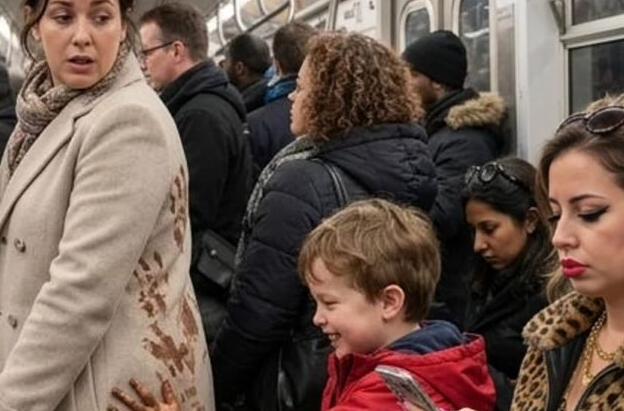
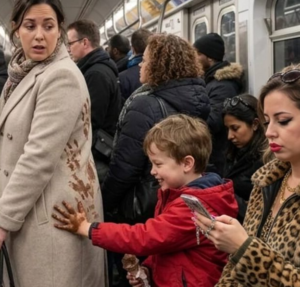
A little boy smeared chocolate all over my coat while his mother laughed. I was on the verge of tears. Then an elderly stranger gave me a knowing wink, and just seconds later, the woman started screaming.
The man handed her a white handkerchief.
At first, I couldn’t understand why she had screamed.
Then she unfolded it.
Inside was a large brown stain.
Chocolate.
A lot of chocolate.
It had stained the handkerchief and the front of the expensive cream-colored designer handbag resting on her lap.
She jumped up so suddenly that she nearly knocked her son off her knees.
“What the hell?!”
The man sitting beside her calmly stood up as well.
He looked about sixty, perhaps a little older. He wore a dark wool coat and carried a canvas shopping bag.
“Please calm down. It’s only chocolate,” he said.
Several passengers around us began laughing.
The woman stared at him.
“You ruined my handbag!”
The man raised his eyebrows.
“Did I?”
She pointed at the brown stain.
“This bag cost twelve hundred dollars!”
He nodded thoughtfully.
“That must be upsetting.”
I covered my mouth with my hand.
The woman looked at me, then back at him.
“You did that on purpose!”
The man shrugged.
“Your son dropped some melted chocolate on the seat between us. I tried to clean it up with my handkerchief, but you placed your handbag right on top of it.”
He gestured toward her bag.
“You put it directly on the chocolate before I could finish cleaning.”
That was when everything became clear.
He hadn’t smeared chocolate on her handbag.
She had done it herself.
The boy had dropped half a chocolate bar onto the seat between them. The man had tried to pick it up, but his mother moved her handbag into the very same spot.
Now one of the bottom corners of the expensive bag was covered in melted chocolate.
The coincidence was so perfect that half the passengers seemed to think fate itself had arranged the whole scene.
The man looked at me and winked again.
Only then did I understand his earlier gesture.
He hadn’t been planning revenge.
He had simply noticed what was about to happen and decided not to rescue the woman from the consequences of her own carelessness.
“You could have warned me!” she protested.
The man looked genuinely surprised.
“Warned you?”
“About the chocolate!”
He tilted his head slightly.
“How interesting.”
Then he looked at my coat.
“I thought grown adults were supposed to know how to handle being around children.”
The woman fell silent.
Someone behind me burst out laughing.
Another passenger remarked:
“Maybe you should call a taxi.”
That brought even more laughter.
I have to admit that, at that moment, I didn’t exactly feel victorious.
I was simply exhausted.
My name is Jenna. I’m thirty-two years old, and I’m practically raising my two-year-old daughter, Mia, on my own.
Her father hadn’t completely disappeared from our lives, but I couldn’t rely on him.
Sometimes he took our daughter for a weekend. Sometimes he sent money when he remembered. He canceled visits so often that I stopped telling Mia he was coming until he actually showed up at our door.
I worked as a receptionist at a physical therapy clinic in Manhattan. My commute was long, and my salary barely covered our basic expenses.
That morning, Mia was sick.
A fever, a cough, and a sleepless night.
My sister stayed with her because I’d already missed two days of work that month and couldn’t afford to miss another.
I left our apartment feeling like a terrible mother.
And twenty minutes later, a five-year-old boy smeared chocolate all over my only decent winter coat.
To some people, that might have seemed like a small inconvenience.
The coat wasn’t expensive. I’d bought it on sale two years earlier. But it was the coat I wore to work. It was what helped me look as though I had my life under control.
Now the back of it looked as though someone had used their fingers to spread an entire chocolate bar across the fabric.
I asked the boy’s mother to intervene.
I didn’t demand money. I didn’t even insist on an apology.
I simply said:
“Could you please stop your son?”
But she refused.
And that hurt more than anything.
It wasn’t the child’s behavior itself. Children do silly things sometimes.
My daughter once colored half our hallway with a purple crayon while I was making dinner. She was only two.
I didn’t start screaming at the wall. I simply cleaned everything up.
The problem wasn’t that the boy had misbehaved.
The problem was that his mother believed that if her child’s behavior inconvenienced someone else, it was no longer her responsibility.
The woman looked at her handbag again.
The stain was awful. It looked even worse than the chocolate on my coat because every drop stood out against the light-colored leather.
She pulled a packet of wet wipes from her bag and started rubbing the dirty area.
The older man warned her:
“I wouldn’t recommend doing that.”
She looked up.
“Excuse me?”
“You might only spread the stain further.”
“Oh, so now you’re a leather expert too?”
“No.”
“Then mind your own business.”
He nodded.
“As you wish.”
The woman rubbed even harder.
The stain really did begin spreading.
I had to turn away to keep from laughing.
Meanwhile, her son was still eating chocolate.
That amazed me most of all.
His mother hadn’t even taken the candy away from him. She was too busy battling the stain on her handbag.
The boy looked at me, then at my coat, and quietly said:
“I’m sorry.”
I barely heard him.
I looked down.
“What did you say?”
His mother stopped rubbing the bag.
The boy repeated:
“I’m sorry I got chocolate on your coat.”
That was it.
The apology I’d been waiting for.
From a five-year-old child.
I leaned toward him as much as the crowded subway car allowed.
“Thank you.”
He looked embarrassed.
“I was making handprints.”
“I understand.”
“I thought it was funny.”
“I understand.”
“Are you mad?”
“A little.”
His face immediately fell.
“But I’m glad you apologized.”
He nodded.
And that was when his mother interrupted.
“Don’t you dare apologize to her!”
The atmosphere in the subway car changed instantly.
I straightened up.
“Excuse me?”
The woman wasn’t looking at me. She was glaring at her own son, clearly furious.
“You’re a child! You don’t have to apologize just because some grown woman can’t take a joke!”
The boy looked at her in confusion.
The older man slowly folded his stained handkerchief.
Then he said:
“Ma’am.”
She spun around.
“What?!”
“Your son has shown more manners in the last ten minutes than you have.”
The woman’s face turned red.
“Nobody asked for your opinion!”
“That’s true.”
He slipped the handkerchief into a small plastic bag.
“But you keep making your behavior everyone else’s problem.”
A woman sitting across from us laughed.
The boy’s mother looked around and realized nobody was supporting her.
That seemed to upset her even more than her stained handbag.
She grabbed her son by the wrist.
“We’re getting off!”
The train was still moving.
The boy protested softly:
“But this isn’t our stop.”
“I don’t care!”
She shoved the remaining chocolates into her bag and looked at me.
“Happy now?”
“No.”
She raised her eyebrows in surprise.
I continued:
“My coat is still covered in chocolate.”
The woman rolled her eyes.
“What do you want from me?”
I thought for a moment.
“I want you to teach your son something simple. When you damage someone else’s property, you can’t just tell them to ignore it.”
She opened her mouth but said nothing.
At that moment, the train doors opened.
The woman pulled her son toward the exit.
Before leaving the car, he turned around.
“I’m sorry again.”
I smiled.
“Thank you.”
The doors closed.
For a few seconds, the subway car was silent.
Then the older man looked at me.
“Take off your coat.”
I blinked.
“Excuse me?”
“Take it off. Chocolate is easier to remove before it dries.”
I hesitated.
The car was still crowded.
He pointed to an empty seat.
“Please, sit down.”
I did.
The man’s name was Harold. He was sixty-seven years old.
It turned out he was a retired high school chemistry teacher who apparently believed that qualified him to solve every stain-related emergency in New York City.
He opened his canvas shopping bag.
Inside were groceries: bread, milk, oranges, and, rather strangely, a bottle of sparkling water.
I looked at it curiously.
“Do you always carry that around?”
“I’m planning to make some drinks tonight.”
“I see.”
He took out a clean cloth.
It wasn’t a handkerchief but a brand-new kitchen towel, still in its packaging.
Harold tore open the wrapper.
“With most chocolate stains, it’s better to use cold water rather than hot.”
“I have to be at work in forty minutes.”
“Then let’s make good use of those forty minutes.”
I could barely suppress a laugh.
The woman sitting across from us offered him a packet of tissues. Another passenger offered a bottle of water. Someone recommended a dry cleaner on 43rd Street that offered same-day service.
Over the next several stops, complete strangers worked together to help me remove chocolate from my coat.
New York has a reputation for being a city where nobody cares about anybody else.
Sometimes that really is how it feels.
Everyone is tired, rushing somewhere, and staring at their phones.
But every once in a while, something unexpected happens.
And suddenly eight strangers are working together to save someone’s coat.
We couldn’t remove the stain completely, but it became much lighter.
Harold decided a professional dry cleaner should handle the rest.
I grimaced.
“I’m afraid I can’t afford that right now.”
He looked at me.
“How much does it cost?”
“I don’t know. Maybe thirty or forty dollars.”
He reached for his wallet.
I immediately stopped him.
“No.”
“I haven’t offered anything yet.”
“I know what you’re about to do.”
“Apparently, you can read minds.”
“I can’t accept your money.”
“Why not?”
“Because none of this is your fault.”
He looked surprised.
“It’s not your fault your daughter got sick, either. But I imagine if a doctor offered you medicine, you’d accept it.”
“That’s completely different.”
“No, but I thought my argument was rather good.”
“Not really.”
He smiled.
Then he pulled out a business card and wrote something on the back.
“Take your coat to Martin’s Dry Cleaners on 44th Street. Tell them Harold sent you.”
I looked at him.
“Why?”
“It used to belong to my wife. She’s retired now, and our nephew runs the business.”
I was still hesitant.
“He’ll charge me, though.”
“I certainly hope so. Otherwise, he won’t stay in business very long.”
“Then why—”
“He’ll give you a good discount.”
I laughed.
“So it’s not free.”
“You’re very suspicious.”
“I’m a single mother in New York.”
“Fair enough.”
I took the card.
“Thank you.”
He nodded, then added:
“Oh, and by the way, that stained handbag wasn’t karma.”
I looked at him.
“What do you mean?”
The woman across from us laughed again.
Harold continued:
“Later, people will tell this story and say karma ruined her handbag.”
He shook his head.
“Her son dropped chocolate. She put her handbag on top of it. That’s simply cause and effect.”
I smiled.
“That doesn’t sound quite as poetic.”
“But it’s more accurate.”
He was right.
No supernatural force had punished the woman.
She had simply ignored her own child’s behavior for so long that the mess eventually affected something she actually cared about.
And somehow, that seemed more meaningful.
By the time we’d finished cleaning my coat and I reached the office, I was twenty minutes late.
My boss, Denise, looked at me and asked:
“What happened?”
“Chocolate attack.”
She stared at me in confusion.
I turned around.
Several faint handprints were still visible on the back of my coat.
“Oh my God!” Denise exclaimed.
I started laughing.
I was so exhausted that I couldn’t stop.
I told her the entire story.
By the end, she was laughing too.
Then she said:
“Go to the bathroom.”
“Why?”
“I have a sweater in my office. Put it on and hang up your coat.”
“I’ll look ridiculous.”
“Right now, you look like Willy Wonka just attacked you.”
Well, it was hard to argue with that.
During my lunch break, I called the dry cleaner.
Harold’s nephew answered.
When I explained the situation, he let out a long sigh.
“Uncle Harold?”
“Yes.”
“And what did he promise you?”
“Nothing.”
“That’s even worse.”
I burst out laughing.
He asked me to bring the coat in after work.
When I arrived, he examined the stains carefully.
“Chocolate. Mostly milk, sugar, and cocoa butter.”
“Can you save it?”
“Most likely.”
“How much will it cost?”
He waved a hand.
“Twenty dollars.”
I knew that wasn’t the usual price.
“Harold already told you about me?”
“Harold tells everybody everything.”
“Really?”
He smiled.
“Consider it a referral discount.”
Two days later, my coat looked almost new.
If someone inspected it very closely, they might still notice a tiny, barely visible mark near one of the seams.
But nobody at work noticed anything.
I did, though.
Every time I looked at the coat, I remembered that woman and felt angry all over again.
Then, about a month later, something else happened.
It was a Saturday, and I was riding the subway with Mia.
The car wasn’t very crowded.
My daughter sat beside me, eating a small packet of crackers.
I was exhausted again.
I suppose there’s simply no other way to live with a two-year-old.
I looked at my phone for literally thirty seconds.
When I looked up, Mia had somehow pulled a red crayon out of her pocket.
To this day, I have no idea how it got there.
She was drawing on the plastic panel beside the seat.
My heart jumped into my throat.
“Mia!”
She froze.
A bright red line stood out clearly on the panel.
A man standing nearby looked down.
I wanted the floor to swallow me.
But then I remembered the chocolate incident.
I took the crayon from my daughter’s hand.
“No. We don’t do that.”
Mia asked in a trembling voice:
“Why?”
“Because we don’t draw on things that don’t belong to us.”
Her lower lip began to tremble, and she burst into tears.
The other passengers started looking at us.
But I didn’t tell them to mind their own business.
I didn’t try to excuse what she’d done by saying she was only little.
Yes, she was little.
But that didn’t mean I could leave the mess for somebody else to clean up.
I started searching my bag for wet wipes.
The red line barely budged.
The man standing nearby suggested:
“Try rubbing alcohol.”
I gave him a weak smile.
“Do you happen to carry that around with you?”
As it turned out, he did.
He had a small bottle of hand sanitizer.
We tested it on a small section, and it worked.
I cleaned the entire surface.
Mia cried the whole time.
Then I asked her to apologize.
To whom, exactly?
Honestly, I wasn’t entirely sure.
The train? The transit authority? The man who helped us?
At two years old, she didn’t fully understand those things yet.
But I wanted her to begin learning one simple rule.
If you make a mess, stop, help clean it up, and say you’re sorry.
Later, I found myself thinking about the chocolate boy again.
He was five.
In a way, he was old enough to understand that what he was doing was wrong.
But he was still a child who needed someone to explain how to behave.
And despite his mother’s attitude, he had found the courage to apologize on his own.
That gave me hope.
Because the most unpleasant person in that subway car hadn’t been the five-year-old boy smearing chocolate.
Children test boundaries.
They do silly things just to see what will happen.
The real problem was the grown woman teaching her son that other people’s boundaries didn’t matter as long as he was having fun.
I never saw either of them again.
New York is too big a city for such perfectly arranged endings.
I don’t know whether the woman managed to clean her handbag.
I don’t know whether the stain disappeared or whether she remembered Harold’s words.
Maybe she went home convinced that everyone on the subway had treated her unfairly.
Or maybe, over time, she came to understand what had happened.
I hope it was the second.
Mostly for her son’s sake.
But I really did meet Harold again.
About six months later.
On the same subway line, but at a different station.
He was reading a newspaper.
I almost walked right past him, but I recognized his canvas shopping bag.
“Harold?”
He looked up.
At first, he didn’t recognize me.
Then he pointed at my coat.
“The chocolate lady!”
I smiled.
“Apparently, that’s my official name now.”
He laughed.
“They did a wonderful job cleaning it.”
I turned around so he could inspect the coat.
“Only twenty dollars.”
He nodded.
“My nephew is getting greedy.”
I laughed.
Mia was with me that day, too.
Harold looked at her.
“Is this your daughter?”
“Yes.”
Mia hid behind my leg.
I explained:
“She usually doesn’t like strangers very much.”
“Excellent instinct,” he replied.
Then I told him the story about the red crayon.
He laughed so loudly that several passengers turned around.
“Looks like karma caught up with me, too,” I said.
He shook his head.
“No.”
“Cause and effect?”
“Exactly.”
I smiled.
Before our train arrived, Harold said something I would remember for the rest of my life.
“Children aren’t born knowing where their own boundaries end and other people’s begin.”
I looked at him.
He continued:
“That’s exactly what parents are supposed to teach them.”
The train arrived.
We boarded different cars.
But his words stayed with me.
At first, I thought this story was about a rude mother who got a taste of her own medicine.
And yes, I’ll admit it honestly: watching chocolate stain her expensive handbag gave me tremendous satisfaction.
But over time, I realized the most important moment had happened before she even left the train.
Her son apologized.
Nobody forced him. Nobody threatened him.
He looked at what he’d done, noticed that I was upset, and understood that he’d crossed a boundary.
And then his own mother tried to teach him not to care.
I hope that lesson didn’t stay with him.
And I truly hope he remembered his own apology.
Because one day, that little boy will grow up and become another passenger on a crowded train.
And he’ll have to decide whether other people are simply obstacles standing between him and whatever he wants, or whether he’ll understand that sharing a city means noticing when our actions cross someone else’s boundaries and damage something that belongs to them.
Preferably without chocolate.