

“Mom, if you can really hear me, please answer Dad this time too. I can’t keep hiding the truth from him.”
I stood frozen behind the partially open door of the hospital room.
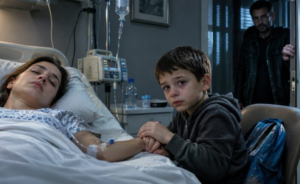
My seven-year-old son, Oliver, was sitting beside my wife’s bed. His small hand held his mother’s fingers, while his other hand clutched his old blue backpack.
“Mom, I know you’re scared,” he continued. “But Dad is a good person. He just doesn’t know what happened that day.”
My breath caught in my throat.
What did he mean?
What did my son know about the day my wife became ill?
I slowly pushed the door open.
“Oliver.”
My son jumped.
He immediately let go of his mother’s hand and hid his backpack beneath the chair.
“Dad… why did you come back?”
“What were you saying to Mom?”
“Nothing.”
“I heard what you said.”
His face turned pale.
“Please don’t be angry.”
I knelt in front of him.
“I’m not angry, son. But I want to understand.”
He looked at his mother, then at me.
“Dad, do you think Mom can hear us?”
“I wish I could believe that more than anything.”
“What if I told you she doesn’t just hear me? She answers me too.”
My heart tightened painfully.
“Oliver…”
He interrupted me.
“I know what you’re going to say. Everyone says I’m too little and that I’m imagining things. But I’m not lying.”
Then he said something that kept me awake all night.
“Dad, do you know why Mom is afraid of Saturdays?”
Two months earlier, my life had been completely different.
My name is William Carter. I was forty-two years old, and my wife, Catherine, was thirty-nine.
After twelve years of marriage, I thought I knew my wife better than anyone else.
But over the past few months, her behavior had changed.
She often remained silent when I came home.
Sometimes I woke up in the middle of the night and found her sitting in the kitchen, staring at a cup of tea that had gone cold.
One evening, I asked her:
“What’s wrong?”
She replied:
“William, if something ever happens to me, will you believe Oliver?”
I laughed.
“What a strange question!”
She didn’t smile.
“Promise me you’ll listen to him.”
“Of course I’ll listen to him.”
At the time, I didn’t understand why she was being so serious.
A week later, I left on a business trip.
And it was on that very day that something happened that changed our lives forever.
That evening, my mother called me.
“William, you need to come home immediately.”
“Mom, what’s going on?”
“Catherine is in the hospital.”
“What happened to her?”
My mother fell silent.
“The doctors say her condition is serious. She hasn’t regained consciousness.”
I nearly dropped my phone.
When I arrived at the hospital, the doctor explained that Catherine had suddenly lost consciousness at home because of a serious neurological problem.
Oliver was the one who had found her and called for emergency help.
But what worried me most was my son’s behavior.
He sat beside his mother’s bed, completely silent.
When I approached him, he suddenly asked:
“Dad, did you talk to Mom this morning?”
“No, son. Why?”
He lowered his head.
“No reason.”
That was the first day I felt that my son was hiding something from me.

Over the following weeks, Oliver hardly ever left the hospital.
After school, he went straight to see his mother, did his homework beside her bed, and told her about his day.
But on Saturdays, his behavior changed.
He refused to leave the room, even to have lunch.
Once, I heard him whisper into his mother’s ear:
“Not yet, Mom. I haven’t told him yet.”
When I asked what he was hiding from me, my son burst into tears.
Another day, I saw him take a notebook out of his backpack, but as soon as he noticed me, he quickly hid it.
“What’s in there?”
“My conversations with Mom.”
“Oliver, Mom can’t talk.”
His eyes filled with tears.
“You only say that because you never stay long enough.”
Those words hurt.
But he was right.
I visited Catherine every day, but I could never bring myself to sit beside her for very long. I always found an excuse to leave, whether it was a phone call or something related to work.
Because the silence of that hospital room reminded me of our last argument.
Before my business trip, Catherine had begged me to stay home.
“William, I haven’t been feeling well lately.”
“Then go see a doctor. I can’t abandon my work.”
She had looked at me with pain in her eyes.
“One day, you’ll regret not listening to me.”
Those words had haunted me for two months.
That Saturday evening, I decided I wasn’t going to leave.
“Oliver, I’m staying here tonight.”
My son looked worried.
“What if Mom doesn’t answer?”
“I’ll stay anyway.”
It was almost nine o’clock in the evening.
The nurse checked the equipment and left the room.
Oliver approached the bed.
“Mom, Dad is here today too. Please do it the way we practiced.”
He took Catherine’s hand.
“If you can hear me, squeeze my finger once.”
A few seconds passed.
Nothing happened.
I was about to speak when my son whispered:
“Don’t rush, Dad.”
And suddenly, I saw it.
Catherine’s index finger moved slightly.
I held my breath.
“Oliver, ask her again.”
He repeated the question.
Her finger pressed gently against his once more.
I jumped to my feet.
“I’m going to get the doctor!”
But my son grabbed my hand.
“Wait! You still don’t know the most important part.”
He opened his little notebook.
On the first page, he had written:
“One squeeze means YES. Two squeezes mean NO.”
The following pages were filled with questions.
“Mom, can you hear me?”
“Do you remember our dog?”
“Do you want Dad to stay?”
But when I read the question on the last page, I froze.
“Mom, before you got sick, did you try to tell Dad that you weren’t feeling well?”
Beside it, he had written: “YES.”
I looked at my son.
“How do you know?”
“Mom answered me.”
Then Oliver suddenly said:
“Dad, do you know what happened that morning when Mom got sick?”
I shook my head.
“Before taking me to school, Mom sat down on the kitchen floor. I got scared. She told me she had a terrible headache. I offered to call you, but she said you had an important meeting.”
My eyes filled with tears.
“And then?”
“She hugged me and said, ‘If Dad ever thinks all of this is his fault, tell him I love him very much.’”
I grabbed the edge of the bed to keep myself from falling.
“Why didn’t you tell me sooner?”
Oliver began to cry.
“Because every time I tried to talk to you about Mom, you left.”
I pulled my son into my arms.
At that moment, I finally understood why Catherine had asked me to believe Oliver before she became ill.
She knew our son would be able to tell me what I had never taken the time to listen to.
But one question still remained.
“Oliver, why did you say Mom was afraid of Saturdays?”
He wiped away his tears.
“I was the one who was afraid, Dad. On Saturdays, I stayed with her all day. Sometimes she wouldn’t answer for a long time, and I thought maybe she would never talk to me again. But I didn’t want you to worry.”
I held him even tighter.
“Son, you don’t have to carry that fear alone anymore.”
Then I turned toward Catherine.
“My love, I’m so sorry I didn’t listen to you. But please, don’t give up. I’m here.”
Oliver took his mother’s hand.
“Mom, Dad thinks you’re angry with him. Is that true?”
A few seconds later, we felt two faint squeezes.
No.
I began sobbing.
“Catherine, do you forgive me?”
A long silence filled the room.
Then I felt one gentle squeeze.
At that moment, Oliver suddenly cried out:
“Dad, look!”
A tear was running from the corner of Catherine’s closed eye.
I immediately called the nurse.
Moments later, the doctor on duty arrived and began checking my wife’s responses.
At first, Catherine didn’t react.
But when the doctor asked her to move the fingers of her right hand, she followed the instruction.
The doctor’s expression grew serious.
“Mr. Carter, this is an important change. We’ll need to conduct further tests.”
“Is she going to wake up?”
“It’s still too early to say, but these responses are encouraging.”
I looked at Oliver.
He was smiling through his tears.
“See, Dad? I wasn’t lying.”
The following weeks passed in anticipation.
Catherine didn’t wake up immediately, but little by little, she began responding more frequently to the doctors’ instructions.
I reduced my working hours and spent every evening sitting beside her.
Oliver was now sleeping at home. We had agreed that he also needed to go to school, play, and get some rest.
Three weeks later, on another Saturday, my son brought a drawing for his mother.
In the picture, all three of us were standing in front of our house.
At the top, he had written:
“MOM, WE’RE WAITING FOR YOU.”
Oliver showed the drawing to his mother.
“When you come home, we’ll have breakfast together every Saturday. Dad already promised me.”
I smiled.
“And this time, I’ll keep my promise.”
Suddenly, I heard a very faint voice.
“O… li…”
I froze.
Catherine’s eyes were open.
She was looking at our son.
“Mom?” Oliver whispered.
Catherine’s lips moved again.
“Oli… ver…”
My son approached her, crying.
I immediately called the doctors.
Catherine was extremely weak, but she was looking at us consciously. The doctors began assessing her condition.
She spoke very little that day.
But when we were finally alone, she looked at me and whispered:
“William…”
I took her hand.
“I’m here, my love.”
Her eyes filled with tears.
“I… could hear you…”
I began to cry.
“I know. Oliver taught me how to listen to you.”

Catherine slowly turned her head toward our son.
“My brave little boy…”
Oliver kissed his mother on the cheek.
“I knew you’d come back to us.”
That evening, as I was driving my son home, he suddenly asked:
“Dad, do you understand now why I never wanted to leave the hospital on Saturdays?”
“Yes, son. Now I understand.”
“I was afraid that if I left, Mom might try to answer and nobody would notice.”
I pulled the car over to the side of the road and held him tightly in my arms.
For two months, I had believed my son was losing touch with reality, desperately longing to hear his mother’s voice again.
But the truth was that he had noticed something the rest of us had overlooked.
And the most painful realization was that my seven-year-old son had managed to hear my wife even in her silence, while I had failed to listen to her when she was still able to speak.