At 64, I never imagined that the very people I loved most would make me feel like a stranger.
None of my children had called me in three weeks. Every morning, I checked my phone, hoping to see their names appear on the screen.
“They’re busy,” I told myself. “They have their own lives.”
But on one rainy Sunday, the loneliness became unbearable.
I bought some chocolates for my grandson and went to my daughter’s apartment.
When she opened the door, her smile appeared just a second too late.
“Dad! What a surprise!”
She hugged me, but something felt different.
Inside, my son-in-law barely looked up from his phone. My grandson greeted me without even putting down his tablet.
“Dad, you should have called first,” my daughter whispered.
I pretended not to notice her discomfort.
During dinner, I tried to tell a funny story from her childhood. Nobody laughed.
Then I noticed my daughter exchanging nervous glances with her husband.
When I stepped into the hallway for a moment, I heard him whisper:
“How much longer is he planning to stay?”
My daughter’s answer broke my heart.
“Just be patient a little longer. He’ll leave soon.”
I stood frozen in place.
For forty years, I’d sacrificed everything for my children. I’d worked double shifts, skipped vacations, and gone without things I needed so they could have everything.
And now it seemed my presence was nothing but a burden.
I returned to the table and silently picked up my coat.
“I’d better get going.”
My daughter smiled.
“Already, Dad?”
But I saw the relief in her eyes.
Outside, I walked home through the rain, crying like a little boy.
That evening, I made myself a promise.
I would never visit my children again unless they invited me themselves.
If they wanted to see their father, they knew where to find me.
Days passed. Then weeks.
Nobody called.
Instead of begging for attention, I began rebuilding my life. I joined a walking group, repaired my old guitar, and started spending time with people who genuinely enjoyed my company.
For the first time in years, I felt alive again.
But exactly three months after that painful Sunday, something happened that my children could never have imagined.
And everything changed.
Three months after I stopped visiting my children, my daughter appeared at my door on a Friday evening at nine thirty.
Her face was pale. Her eyes were swollen from crying.
And her first words nearly made my heart stop.
“Dad… please tell me you haven’t sold the house.”
I stared at her.
“Emily, what are you talking about?”
Without answering, she stepped inside.
Behind her stood my son, Michael, holding an envelope.
“We went to the bank today,” he said. “They told us you’ve withdrawn almost all your savings.”
I looked from one frightened face to the other.
“So that’s why you’re here?”
Emily shook her head.
“No, Dad. That’s not why. But we need to understand what’s going on.”
For a moment, I considered telling them everything.
Instead, I invited them into the living room.
The same living room where their mother used to help them with their homework, where we celebrated birthdays, and where I’d spent countless evenings waiting for their phone calls.
Emily noticed that some photographs had disappeared from the shelves.
“Where are all our family pictures?”
“I put a few away.”
“Why?”
I took a deep breath.
“Because I’ve finally started living again.”
Michael frowned.
“Dad, you’re sixty-four. You can’t just withdraw all your savings and disappear without telling anyone!”
His words hurt.
“Disappear?” I repeated. “Michael, I haven’t heard from you in three months.”
He looked away.
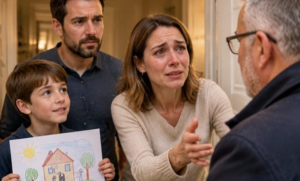
Emily began to cry.
“We thought you were angry with us.”
“I was hurt,” I admitted. “That’s different.”
Then I told them about that Sunday.
About the forced smiles.
About the conversation I’d accidentally overheard.
About how I’d walked home crying through the rain, wondering whether my own children still wanted me in their lives.
Emily covered her mouth with her hand.
“Oh, Dad…”
Michael sank heavily into a chair.
For a long time, neither of them said anything.
Finally, Emily whispered:
“Why didn’t you tell us?”
I looked at her.
“Because I wanted you to notice it yourselves, without me having to say anything.”
At that moment, Michael’s eyes fell on a framed photograph beside my armchair.
In the picture, I was smiling in front of a small building, surrounded by several elderly people.
“What’s this?”
I picked up the photograph.
“Something your mother and I dreamed about years ago.”
Before Margaret passed away, we’d often talked about opening a small community center for elderly people who lived alone.
A place where no one would have to spend their birthday by themselves.
A place where there would always be someone who remembered your name.
After her death, I’d given up on that idea.
I told myself that my children needed me more.
But during those three lonely months, something changed.
At my walking group, I met Helen, a seventy-eight-year-old widow.
She hadn’t spent Christmas with her family in six years.
Then I met George, a retired teacher whose children lived just twenty minutes away but rarely visited him.
And one afternoon, Helen said something I’ll never forget.
“Robert, loneliness doesn’t mean you have nobody. It means being surrounded by people who make you feel invisible.”
That evening, I took out Margaret’s old notebook.
Inside, she’d written down the plans for our shared dream.
I realized I still had time to make that dream come true.
So I used part of my savings to rent an empty storefront near the park.
I bought secondhand tables, chairs, books, and a coffee machine.
With the help of my new friends, I transformed the space into a warm, welcoming place where people could gather.
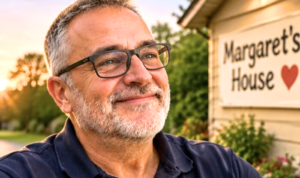
We called it Margaret’s House.
The opening was scheduled for the following morning.
Emily stared at me in disbelief.
“You did all of this… completely on your own?”
I smiled.
“Not alone. I had people around me who genuinely wanted to be there.”
Her face tightened with sadness.
Michael picked up the photograph again.
“Why didn’t you ask us for help?”
I looked at him calmly.
“Would you have had the time?”
He opened his mouth.
Then closed it again.
For the first time, my children had no answer.
The next morning, I arrived at Margaret’s House before sunrise.
I expected perhaps fifteen visitors.
Instead, more than sixty people were waiting outside.
Helen had invited her neighbors. George had contacted his former colleagues. Volunteers brought flowers, homemade cakes, and handwritten welcome cards.
And near the entrance stood Emily, Michael, Daniel, and my grandson Ethan.
I froze.
Emily walked toward me.
“Dad, we know we can’t undo what happened. But please, let us be here with you today.”
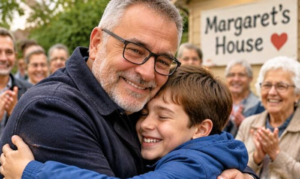
Before I could answer, Ethan ran toward me.
“Grandpa!”
He wrapped his little arms around my waist.
“I made something for you!”
He handed me a drawing.
It showed a small house surrounded by smiling people.
At the top, in crooked letters, he’d written:
“GRANDPA’S HOUSE, WHERE NOBODY IS LONELY.”
My eyes filled with tears.
Then Michael stepped forward.
“Dad, I’ve taken the weekend off. If you need shelves put up or anything repaired, I’m here.”
Emily added:
“And I brought something too.”
She opened her bag and took out a framed photograph.
It was a picture of Margaret and me on our wedding day.
“Mom should be here too,” she whispered.
I couldn’t say a word.
Together, we hung the photograph near the entrance.
Then something happened that none of us had expected.
Helen walked over to my children.
“Are you Robert’s family?”
Emily nodded.
Helen took her hands.
“Your father saved me.”
Emily looked at her in surprise.
Helen continued:
“Three months ago, I barely left my apartment. I felt forgotten. Your father started visiting me every Tuesday. He brought me groceries, fixed my broken radio, and reminded me that my life still had value.”
She looked at me.
“And now he’s doing the same thing for dozens of other people.”
Emily began to cry again.
But this time, I understood why.
She was seeing a side of me she’d forgotten existed.
Not just her father.
Not just the man who babysat his grandson, brought presents, and always showed up whenever someone needed him.
But a person with dreams.
A person with feelings.
A person whose life still had meaning.
Later that afternoon, Emily found me sitting alone beneath Margaret’s photograph.
She sat down beside me.
“Dad, I owe you an apology.”
I waited.
“That Sunday, I was exhausted. Daniel and I had argued. Ethan had been difficult all day. When you arrived, all I could think about was how inconvenient the timing was.”
Her voice broke.
“But I never stopped to think how much courage it might have taken for you to come and visit us in the first place.”
I took her hand.
“Sweetheart, I don’t need to be the center of your life. I just don’t want to feel like an unwanted visitor.”
She hugged me tightly.
“You’ll never feel that way again.”
Michael came and sat beside us.
“We can’t promise we’ll never be busy, Dad. But we can promise you’ll never have to wonder whether we love you again.”
That evening, after everyone had gone home, I stood outside Margaret’s House and looked at the glowing windows.
For the first time in five years, it felt as though Margaret were standing beside me.
These days, my children visit me regularly.
Sometimes they help out at the center.
Sometimes we share a meal.
And sometimes they simply call to say:
“Dad, we miss you.”
But the biggest change didn’t happen in them.
It happened in me.
I no longer measure my worth by how often my phone rings.
I no longer wait for an invitation to feel important.
And I’ve learned that growing older doesn’t mean becoming invisible.
Sometimes it means finally discovering who you really are when you stop living exclusively for other people.
If your parents are still alive, call them today. Because one day, the very voice you’re too busy to listen to now may become the voice you’d give anything to hear just one more time.
Would you have forgiven your children, or would you have preferred to keep your distance? Tell me in the comments what you would have done.