

For twenty-eight days, I fought for my life in intensive care. Not a single member of my family bothered to visit me. But when my brother decided he wanted my $2.8 million house, my family suddenly remembered that I existed.
My name is Emily Bennett. I’m thirty-five years old, a lawyer specializing in commercial real estate, and I live in Connecticut. But to my parents, I’d always been the daughter who could be sacrificed for the sake of their son.
Six weeks earlier, a drunk driver had crashed into my car on a wet road. I suffered multiple fractures, internal bleeding, and a damaged lung. I underwent three emergency surgeries, and my heart stopped twice.
The hospital staff repeatedly tried to contact my parents. My mother answered only once.
“She always exaggerates. Call me when she’s actually dying,” she snapped at the nurse.
My father didn’t answer a single call. Meanwhile, my younger brother, Kaelan, was posting vacation photos from Miami while I lay unconscious and connected to a ventilator.
When I finally regained consciousness, the only person sitting beside my hospital bed was my best friend, Olivia.
“Your family knows what happened,” she said quietly when I asked about my relatives.
I didn’t need any further explanation.
After four weeks, I was discharged from the hospital. I could barely move without a walker. Olivia drove me home, bought groceries, and helped me climb the stairs. Not one of my relatives even asked how I was feeling.
Then Tuesday arrived.
I was peacefully drinking tea when I received a message from my mother.
“Kaelan needs a house for his new family. His wife is pregnant, and your house has six bedrooms. We want you to transfer the property into his name today.”
I read that message several times. Not a word about my health, not a single question about how I’d survived the accident. Just a demand.
I found a picture of a small children’s play tent online and sent it to my mother.
“Tell Kaelan to move into this.”
Then I blocked her number.
Three hours later, my father’s car pulled into my driveway. Two men carrying leather briefcases stepped out. My father approached the front door and rang the bell several times.
I was still weak, but I had no intention of being afraid of him.
My six-bedroom house wasn’t just an expensive property. It also served as the headquarters of Bennett Property Holdings, a private investment company I’d founded twelve years earlier.
And three months before my accident, my company had purchased the mortgage loan secured by a commercial property belonging to my father’s business, which was on the verge of bankruptcy.
He had absolutely no idea.
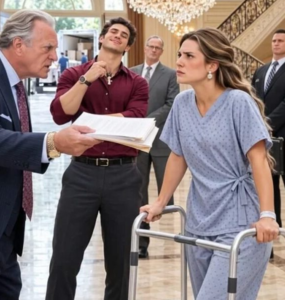
When I opened the door, my father glanced at my walker and gave me a mocking smile.
“Excellent. You’re home. This won’t take long.”
He pulled out some documents.
“Sign these, Emily. Your brother deserves this house.”
I looked at the two lawyers accompanying him.
“Gentlemen, before anyone signs anything, there’s something you should know.”
I stepped aside, revealing the living room.
My people were already waiting inside.
PART 2. THEY HAD CHOSEN THE WRONG DAUGHTER TO INTIMIDATE
Standing in the room was my corporate attorney, Rebecca Shaw. Beside her were a court reporter and a financial analyst named Daniel Price.
My father’s confidence visibly weakened.
“What is this ridiculous performance?”
“We’re simply getting the paperwork in order,” I replied calmly. “I think your lawyers understand exactly what that means.”
One of the men, Michael Grant, recognized Rebecca.
“Ms. Shaw? I didn’t know you represented his daughter’s interests.”
She answered politely.
“I represent the company that holds Mr. Bennett’s mortgage debt secured by his commercial property.”
My father stopped smiling.
“What company?”
“Bennett Property Holdings.”
He laughed nervously.
“That’s impossible. Emily doesn’t own anything except this house.”
For all those twelve years, my parents had assumed I simply worked at a law firm. They’d never shown any interest in my investments, my clients, or my own business ventures.
Kaelan was their talented heir, the son who deserved the very best of everything.
I, on the other hand, was the daughter expected to step aside whenever he wanted something.
My father pulled out the documents again.
“Enough of these games. Sign the deed transferring the house.”
It wasn’t an ordinary gift agreement.
Attached to it was a statement claiming I was voluntarily transferring the property without compensation and that I’d received independent legal advice.
Both statements were lies.
“You prepared these documents without my consent,” I said.
“Your mother explained everything,” Michael replied cautiously.
“No. My mother explained only what she wanted.”
Rebecca placed another binder on the table.
“There’s another issue, and it’s much more serious.”
Daniel opened his laptop.
“While Emily was hospitalized, someone attempted to access her investment accounts using a power of attorney bearing her signature.”
My father stiffened.
“That’s none of your business.”
“Quite the opposite,” Daniel replied. “The document is dated on a day when Emily was unconscious in intensive care.”
My father glanced at his lawyers.
After I’d returned from the hospital, Olivia had found a letter from the bank.
It reported an attempt to change the authority over my accounts.
At first, I thought it must have been a mistake.
But Daniel’s investigation uncovered a forged signature and a mailing address belonging to my father.
“Who prepared that power of attorney?” Rebecca asked.
My father suddenly stood up.
“I was only trying to protect the family assets!”
“My assets,” I corrected him.
At that moment, his phone rang.
It was Kaelan.
My father switched on the speakerphone, apparently forgetting there were other people in the room.
“Dad, has she signed yet? I booked the moving crew for Friday. Tell her she can stay in the guest room until she finds somewhere else to live.”
Michael slowly closed his briefcase.
For the first time, he appeared to realize he’d been misled.
“Mr. Bennett, you told us your daughter had already agreed to transfer the property.”
My father ended the call.
Rebecca took out another document.
“Your commercial loan has overdue payments. The lender has already issued formal notices, and the deadline to cure the default is approaching.”
My father stared at the figures.
“Emily owns that debt?”
“Yes,” Rebecca replied.
“How much?”
“Approximately $3.4 million.”
My father’s face turned pale.
I leaned against my walker and finally spoke.
“You came here to take my house away from me, Dad. But apparently, you forgot to check who now owns the mortgage on your own company’s property.”
He fell silent, then abruptly asked:
“You’re not seriously planning to destroy your own family, are you?”
I looked him straight in the eyes.
“You should have remembered we were family when I was lying between life and death.”
PART 3. THE PRICE OF BETRAYAL
My father left threatening to sue me. But by Friday, his situation had become even worse.
Kaelan arrived at my house in a moving truck. He was accompanied by his pregnant wife, Madison, and six employees from the moving company.
From my living room window, I watched them unload an enormous sofa directly onto my driveway.
My brother rang the doorbell.
“Open up, Emily! Dad said everything’s already been arranged!”
I answered through the video doorbell.
“You have ten minutes to remove your belongings from my property.”
He laughed.
“Stop acting like you’re so important. You live alone in a huge mansion, and we’re trying to start a family.”
“Then buy your own house.”
He kicked my front door.
“Dad says you owe us!”
I called the police.
When the officers arrived, Kaelan announced that the house belonged to him and presented a copy of the unsigned agreement as proof.
One of the officers carefully examined the document.
“This document doesn’t establish your ownership of the property.”
“But my father said…”
“Your father isn’t the owner of this property.”
Madison looked stunned.
“You told me she had given you the house herself.”
Kaelan couldn’t look her in the eyes.
Forty minutes later, the moving truck left my driveway.
The next confrontation took place on Tuesday at Rebecca’s law office.
My father arrived with my mother, Kaelan, and his lawyers. They were expecting family negotiations and a compromise.
Instead, Rebecca laid out the evidence of the attempted fraud involving the power of attorney: bank records, correspondence, handwriting analysis results, and a hospital certificate confirming that I had been unconscious on the date the document was supposedly signed.
My mother began to cry.
“We were only trying to protect your brother!”
Rebecca maintained her professional composure.
“Attempting to take control of someone else’s assets using a forged document has nothing to do with protection.”
My father slammed his hand against the table.
“Emily, tell her to stop!”
I remembered how he’d refused to come to the hospital when I was fighting for every breath.
“No.”
Rebecca informed them that the evidence had already been forwarded to law enforcement and that the bank was conducting its own investigation.
My father’s lawyer requested a private conversation.
When he returned, he announced that he could no longer represent Mr. Bennett in matters concerning the disputed documents.
We then moved on to discussing the commercial property.
After several missed payments, my company had begun acting strictly in accordance with the loan agreement.
We hadn’t demanded immediate repayment of the entire outstanding balance.
Instead, we’d offered my father one final opportunity to restructure the debt: full financial disclosure, independent oversight, and a substantial initial payment toward the arrears.
He refused.
“I will not take orders from my own daughter!”
Thirty days later, after the required legal periods had passed and the necessary notices had been delivered, foreclosure proceedings began against the mortgaged property.
The financial audit uncovered reckless spending, unauthorized transfers of funds, and loans that had actually been used to finance Kaelan’s luxurious lifestyle.
Unable to secure refinancing, my father agreed to sell the property under court supervision.
The proceeds were sufficient to repay a substantial portion of the secured debt, but he lost all the equity he’d invested in the business.
The family company ceased to exist.
Kaelan lost his comfortable management position, and my parents had to sell their luxurious home to settle their remaining obligations.
The investigation into the forged documents continued separately.
Eventually, my father pleaded guilty to an offense involving document forgery.
He received a suspended sentence, was ordered to pay restitution, and the conviction remained on his criminal record for the rest of his life.
Investigators couldn’t gather sufficient evidence against my mother, so she avoided criminal liability.
But the consequences of the family conflict remained.
Six months later, she called me from an unknown number.
“Emily,” she whispered, “we’ve lost everything.”
I was looking through my living room window as sunlight fell across my garden.
“No, Mom. You haven’t lost everything.”
She burst into tears.
“Please…”
“You only lost what you thought you could take from me.”
“But we’re your family…”
I closed my eyes.
Once again, I saw the hospital monitors, the unanswered phone calls, and Olivia’s hand holding mine while everyone else couldn’t even be bothered to show up.
“Family stands beside you when you’re fighting for your life,” I replied. “Not just when they need your signature.”
I ended the call.
A year passed.
I made a full recovery.
Bennett Property Holdings continued to grow, and I established a charitable foundation to help people facing difficult recoveries after serious injuries who had no close family or friends to support them.
Olivia became the foundation’s director.
Kaelan found an ordinary job after Madison separated from him.
My parents moved into a small rented apartment.
I didn’t take pleasure in their difficulties.
I simply refused to keep paying for them.
One evening, Olivia and I sat on the terrace, watching the sun disappear behind the trees.
“Do you ever regret how everything turned out?” she asked.
I remembered the intensive care unit, the ignored phone calls, the forged documents, and the moving truck parked outside my house.
Then I smiled.
“I regret only one thing: spending thirty-five years believing that love was something I had to earn.”
Olivia raised her glass.
“And now?”
I looked at the warm light glowing through the windows of my peaceful home.
“Now I know that surviving everything was only the beginning.”
They tried to take my house because they believed I was defenseless.
But in the end, they realized that the daughter they had once abandoned had finally learned to stand up for herself and demand accountability from those who had hurt her.