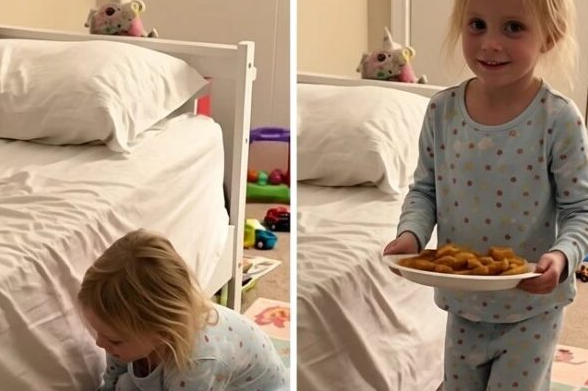
My granddaughter asked for a second helping of dinner, but then hid the food under her bed. The next morning, the plate was empty. When I tried to make her stop, she cried harder than she had after her mother’s car accident. That’s when I bought a security camera. At 2:43 a.m., the blanket began to move, and I finally saw who she had been saving her dinner for all this time.
Lily set a third plate beside Selena’s empty chair.
She straightened the napkin as though someone might notice at any moment that it wasn’t positioned properly.
“Sweetheart, it’s just going to be the two of us for dinner tonight.”
She looked at the fork, then raised her eyes.
“Just in case.”
I left the plate where it was.
My daughter had always sat there during our Sunday dinners.
It seemed perfectly natural to me to keep a place for her.
Three weeks after Selena’s accident, Lily came to live with me.
Her pink backpack could barely hold all the belongings she’d insisted on bringing.
But she held a stuffed rabbit tightly under her arm.
Her father had died when she was still a baby.
While her mother recovered, I was responsible for taking care of Lily.
I was 63 years old. I spent my days with my reading glasses slipping down to the tip of my nose, constantly checking messages from the hospital.
Lily was seven and seemed to be handling everything better than I was.
She helped me bake cookies and laughed at the cartoons we watched together.
She also insisted on setting the dinner table herself.
I took her eagerness to help as a good sign.
Selena’s doctors expected her recovery to take a long time.
Sometimes she was too exhausted even to have visitors.
I repeated every reassuring update the hospital staff gave me to Lily.
Then I’d put my phone away before she could notice how worried I really was.
I made sure breakfast was served at eight every morning, and we always baked cookies on Fridays.
Whenever Lily asked about her mother, I smiled a little too quickly.
“Mommy is getting the treatment she needs.”
That was true, but there were still many things we didn’t talk about.
The first time Lily asked for another helping, almost all of her chicken was still untouched on the plate beside her potatoes.
“Finish what’s on your plate first, sweetheart.”
She pushed the food around with her fork but didn’t take a single bite.
“Can I save some for later?”
I was answering a message from the hospital, so I simply nodded.
That evening, I found a chicken drumstick beneath her pillow.
A paper napkin had stuck to the skin.
I carefully removed it from the clean bedding.
“Lily, why is this here?”
She stopped in the doorway and squeezed the ear of her stuffed rabbit more tightly.
“I saved it.”
I waited, hoping she’d explain on her own.
“For whom?”
She looked at the chicken instead of me.
Then she shook her head.
I explained that food could spoil if she left it under her pillow.
She watched silently as I threw the chicken into the kitchen trash.
A moment later, I heard her bedroom door close.
I stood beside the trash can, feeling that I’d been too harsh.
And yet I’d only asked a perfectly ordinary question.
Why couldn’t she simply answer me?
The next morning, I found a sandwich under her bed.
The paper plate was sitting right beside the edge of the bedspread.
The bread had already begun to dry out around the edges.
I took it into the kitchen while Lily ate her cereal.
“Are you waking up hungry during the night?” I asked.
She shook her head and put her spoon back in the bowl.
“We can put something in the refrigerator so the food stays fresh.”
Lily rubbed her thumb along the cuff of her pajamas.
“Do we have any more bread?”
I set the sandwich on the table and, for a moment, didn’t know what to say.
She hadn’t even asked about her own breakfast.
Over the next several nights, food continued to disappear.
First it was cookies, then half of the sandwiches.
More and more often, I found the little plates farther and farther beneath the bed.
One day, a plate I’d left with its opening facing outward had been turned in the opposite direction.
I couldn’t tell whether Lily was eating the food during the night.
She insisted she wasn’t, but she refused to explain anything else.
I checked the food cupboards, the wardrobe, and the space behind the dresser.
I found no signs of animals or spoiled food, and I didn’t hear any scratching sounds.
Eventually, I called a pest-control specialist.
He inspected the bedroom, kitchen, and basement but found no evidence of animals.
After he left, I carefully checked the room myself one more time.
The only thing staring back at me from Lily’s pillow was her stuffed rabbit.
She slept in the guest bedroom on the ground floor, next to the garden.
The low window overlooked the area behind the old shed.
A garden ladder stood directly beneath the windowsill.
I’d liked having Lily close to the kitchen and bathroom.
But now I found myself stopping in her doorway more and more often, listening.
Whenever I stood there, nothing happened.
Whatever it was, it waited until the house fell silent.
That evening, I gave Lily two slices of pizza.
I wanted to see what would happen to the second one.
She looked at my face before taking the plate.
“Are they both for me?”
I nodded and watched her sit down.
She ate one slice and took the other with her.
At ten o’clock, when she was already asleep, I went into her bedroom.
The slice of pizza was sitting on a paper plate beneath the bed.
I left everything exactly as it was and returned to the kitchen.
At midnight, I checked the front door.
At two in the morning, I made myself some tea and listened to the refrigerator humming.
By six o’clock, the plate was empty.
Lily hadn’t called for me or walked down the hallway.
I picked up the plate and held it toward the light.
Only a few greasy marks and crumbs remained.
During breakfast, she kept glancing toward her bedroom.
Instead of clearing the table, I sat down beside her.
“Please, tell me what’s happening to that food.”
She gripped the edge of her chair.
“Grandma, please don’t make me stop.”
I moved the untouched piece of bread away from her elbow.
“Stop doing what, sweetheart?”
She wiped her tears with her sleeve.
“If I stop, someone will go hungry.”
I waited, trying not to pressure her into answering too quickly.
But the moment I asked who she meant, she began crying even harder.
That day, I bought a small motion-activated camera.
I placed it on a bookshelf with the lens pointing toward her bed.
The window was behind the camera and didn’t appear in the recording.
I showed Lily the screen before turning the device on.
“Now I’ll be able to see what’s happening without waking you up.”
She stared at the little black lens.
“Will you take it away afterward?”
I put my phone down so she could see my face.
“When I understand what’s happening and know that you’re safe.”
She nodded and hugged her stuffed rabbit more tightly.
I wished she would ask another question.
That evening, she took an extra serving of potatoes into her bedroom.
I watched her leave before checking my phone.
Selena had written that she was feeling stronger.
After Lily brushed her teeth, we recorded a reply for her together.
Lily talked about school, cookies, and the cartoon she’d watched.
She didn’t mention the little plates or the visitor who needed food.
When we finished, she asked when her mother would come home.
I carefully tucked the blanket over her legs.
“I don’t know exactly what day that will be yet.”
She looked at the third plate that was still sitting on the table.
I left the hallway light on.
The next morning, another little plate was empty.
There was one motion-detection notification on my phone, timestamped 2:43 a.m.
I opened the recording while sitting at the kitchen table.
For several seconds, Lily was sleeping peacefully beneath her pink blanket.
Then the fabric hanging over the side of the bed began to move.
I turned up the volume and leaned closer to the screen.
A small, dark snout appeared beneath the edge.
A moment later, a scruffy brown terrier stepped into view.
He lowered his head over the plate and began to eat.
The camera light reflected off his faded blue collar.
“No… That can’t be.”
I rewound the recording and pressed play again.
Beneath one of his floppy ears was a small, light-colored patch.
I’d scratched him in that very spot so many times that I recognized him immediately.
“Biscuit?”
He finished the potatoes and pushed the plate aside with his nose.
Then he disappeared toward the window, outside the camera’s view.
Lily didn’t even wake up or reach toward him.
I watched the recording all the way to the end.
Two houses down, Mr. Bennett lived with his dog.
Before the accident, Selena had taken Biscuit for walks almost every day.
Mr. Bennett suffered from arthritis, so long walks were difficult for him.
Lily often accompanied them, carrying a small packet of dog treats.
After Selena’s accident, Biscuit had escaped through Mr. Bennett’s garden gate.
I’d helped search for him along the neighboring streets and looked through photographs of the dog.
Mr. Bennett kept asking whether anyone had seen Biscuit.
And now that very same dog was eating beneath my granddaughter’s bed.
I put my phone down and went straight to Lily.
She was standing in front of the mirror, brushing her hair, while I examined the window.
The latch hadn’t clicked fully into place, and the window was slightly open.
One corner of the insect screen was bent back.
Small, dusty paw prints could be seen on the windowsill, leading toward the bed.
I closed the window and secured the latch firmly.
“Did you open this window?”
Her hairbrush stopped halfway through a strand of hair.
“For him.”
I sat beside her and slipped my phone into my pocket.
“You mean Biscuit?”
Lily turned toward the bookshelf.
“You saw him?”
I nodded, and she put down the brush.
“He’s hungry, Grandma.”
I took her hand and asked where he was hiding.
She pointed toward the old shed.
“First under the fence, and then behind the flowerpots.”
She’d found him there while playing in the garden.
Whenever the adults came outside, he hid behind the shed.
The bread she left beside the shed disappeared while she watched the garden through her window.
Gradually, he’d begun coming closer and closer to the open window.
So she’d started bringing the food inside, hoping he would follow her.
And the hanging blanket provided a dark place for him to hide.
“Why didn’t you tell me?” I asked.
Lily began picking at a loose thread near her stuffed rabbit’s ear.
“You said you couldn’t take care of anything else.”
I remembered a phone conversation I’d once had beside the washing machine.
Someone had asked me for another favor.
Lily had been sitting at the kitchen table, drawing.
I’d thought she wasn’t listening.
“I didn’t mean you couldn’t ask for help, sweetheart.”
She continued rolling the thread between her fingers.
“You would have sent him away.”
I wanted to explain where Biscuit really belonged.
But then she said something that stopped me cold.
“Mommy promised to help him.”
Selena had promised Mr. Bennett that she would continue taking Biscuit for walks.
Lily remembered those words better than anything I’d told her lately.
“Even when things get difficult,” she repeated.
She looked at her stuffed rabbit and straightened its twisted ear.
“Then something bad happened to Mommy, and he disappeared.”
I stayed silent, waiting for her to wipe her eyes.
“Mommy couldn’t keep her promises, so I was doing it for her.”
The third plate, the extra food, and the carefully folded napkins.
I’d been so focused on monitoring how much Lily ate that I’d barely asked what was really happening inside her little heart.
I hugged her without taking away her stuffed rabbit.
“You did a good thing by wanting to help Biscuit,” I began.
Lily looked up before I could finish.
“But opening the window and hiding food wasn’t safe.”
She glanced at the latch I’d just secured.
“But he’ll still get dinner?”
I nodded and continued holding her.
“We’ll call Mr. Bennett and help him the right way.”
She nestled against my sweater.
“Do I have to keep all Mommy’s other promises now?”
I let her finish before answering.
“What if she doesn’t come back?”
Every time she asked that question, I’d smiled without understanding what she was really trying to tell me.
I hadn’t understood it when she asked about the hospital visits, either.
Now I pressed my cheek against her hair.
“I was really frightened too, sweetheart.”
She pulled away slightly and looked at me, checking whether I truly meant it.
“Daddy never came back.”
I took her little hand between mine.
“I know, sweetheart.”
There was no cheerful answer that could make that loss hurt any less.
“Mommy is slowly getting better, and the doctors are helping her.”
I wiped the damp edge of her sleeve with a clean napkin.
“You don’t have to earn Mommy’s return home.”
She let go of the stuffed rabbit’s twisted ear.
I gently straightened it.
“Even if I don’t do everything?”
“Even then.”
We sat together until she felt ready to get up.
Before we went outside, I turned off the camera and put it away.
Lily walked into the garden with me, holding my hand tightly.
Instead of leftovers from the previous night’s dinner, I brought fresh water.
Biscuit approached cautiously when Lily crouched beside me.
I set down the bowl of water and called Mr. Bennett.
He came over with Biscuit’s leash and his usual food bowl.
The little terrier emerged immediately when he heard his owner’s voice.
Mr. Bennett carefully sat down on the garden bench.
Biscuit pressed his dusty collar against the outstretched hand.
Lily watched as Mr. Bennett stroked the light-colored patch behind the dog’s ear.
“Mommy said she’d help you,” she explained.
He looked at her over Biscuit’s head.
“And you were trying to keep her promise?”
Lily nodded and leaned against my knee.
I rested a hand on her shoulder.
“Mommy said she’d help you.”
“Now we’ll help her keep her promises together.”
Later that same day, Mr. Bennett took Biscuit to the veterinarian.
I explained exactly what foods Lily had been leaving for the dog.
I also mentioned the chicken drumstick she’d hidden beneath her pillow and explained that the leftovers might have contained bones.
The veterinarian examined Biscuit and explained what food would be best for him.
The dog was underweight, but the veterinarian found nothing that required immediate treatment.
When Lily became frightened that she might have harmed him, I didn’t dismiss her concerns.
We explained that certain food scraps and bones can be dangerous for dogs.
Then we showed her where Biscuit’s proper dog food should be kept.
I repaired the insect screen and closed the gap beneath the fence.
Mr. Bennett checked the garden gate before taking Biscuit home.
During our next hospital visit, Lily told Selena everything.
Even about the chicken drumstick beneath her pillow.
Selena listened, then reached toward her daughter.
“Were you doing my jobs for me?”
Lily nodded and studied her mother’s face carefully.
“Someone had to.”
Selena gently brushed her thumb over her daughter’s little knuckles.
“Grandma will help me keep my promises.”
Lily glanced at me before answering.
“So I can just help a little?”
I moved my chair closer to the bed.
“A little is more than enough.”
Several more weeks passed before Selena could come home. There were minor complications, but there were calmer days, too.
We visited whenever she felt well enough, and between visits, we spoke on the phone.
I stopped hiding all my worries from Lily behind a smile.
If a hospital visit was canceled, I explained why.
Lily was allowed to feel sad, and she no longer felt that she had to cheer me up.
She began asking questions directly instead of hiding them behind extra napkins.
Mr. Bennett sometimes brought Biscuit over to visit.
Lily checked his collar and then asked what he’d eaten.
Eventually, Selena was able to come home with a set of exercises to do and several scheduled medical follow-up appointments.
I carried her bag while Lily held the door open.
That evening, Lily set the table for three all by herself.
Selena carefully sat down in her old place.
Her daughter straightened the napkin beside her mother’s plate.
“I saved your place, Mommy.”
Selena took her hand, the same hand that was still smoothing the edge of the napkin.
“I know, sweetheart.”
Lily looked at the large bowl of potatoes.
This time, she left it right where it was.
“Grandma, could you pass me the potatoes?”
I lifted the bowl, and she moved her plate closer.
This time, no one needed to hide food beneath the bed anymore.