
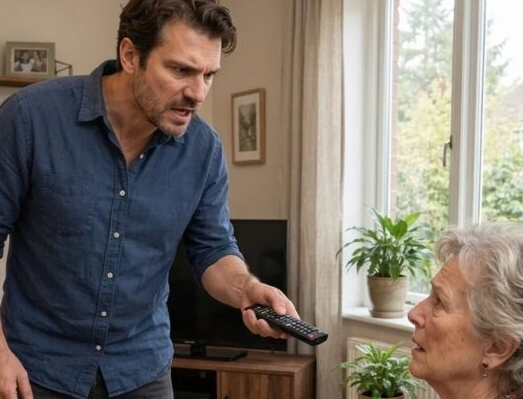
I didn’t realize I had become a guest in my own home until my son-in-law snatched the remote control out of my hands.
I was sitting in the living room, watching the evening news. It was a Thursday in November, around seven thirty. Outside the window, rain covered the garden like a gray curtain, and I had just poured myself a cup of tea.
That was when Daniel walked in.
He was 43 years old. He was my only daughter’s husband, and he had been living under my roof for almost three years.
He didn’t even greet me. He walked over to the coffee table, picked up the remote, and switched off the television.
“That’s enough, old woman. Go to your room. I need some peace and quiet.”
I looked at him.
“What did you say?”
“You heard me. I’ve had a hard day. I’m not going to listen to this news or your constant chatter.”
“But I wasn’t even talking.”
Daniel let out a heavy sigh and adjusted his carefully styled hair.
“Why do you always have to turn everything into an argument? Go to bed, Ingrid.”
I was 71 years old. I had worked as a nurse for 38 years, practically raised my daughter on my own, and said goodbye to my husband after a long illness. But no one had ever spoken to me that way before.
Even during my most difficult shifts in the emergency department, when intoxicated patients shouted and threw things, I had never felt so humiliated.
I stood up slowly.
Daniel smiled with satisfaction.
“There you go. Was that really so difficult?”
I walked past him without saying a word. But I didn’t head toward my bedroom.
I went into my study, closed the door, and took a blue binder from the shelf. It had been sitting there untouched for almost three years.
Now it was time to open it.
My name is Ingrid Lundqvist, and I live in a yellow wooden house on the outskirts of Norrköping.
My husband Lars and I bought this house in 1989. Back then, it was old and neglected. Wind came through the windows, and the kitchen looked as though it had been frozen in the 1970s.
Lars worked in a workshop, and I was a nurse at Vrinnevisjukhuset Hospital. We didn’t earn much, but we knew how to manage our money carefully.
On weekends, we painted walls, repaired floors, and gradually renovated the house. Our daughter Sofia grew up here. She learned to ride a bicycle in the driveway, celebrated her birthdays in the garden, and cried over her first great love at the kitchen table.
When Lars died eight years ago, I thought the house might be too big for me. But I couldn’t bring myself to leave. Every room held memories.
It wasn’t simply a building. It was my entire life.
By then, Sofia was already living in Stockholm and working in marketing. That was where she met Daniel.
He was charming, well dressed, and always talked enthusiastically about his plans for the future. At our first meeting, he brought an expensive bouquet of flowers and a bottle of wine.
“Sofia has told me so much about you,” he said, kissing me on the cheek. “You’re truly a remarkable woman.”
I liked him. It’s hard to believe now, but back then, I genuinely liked him.
Two years later, they got married. When their daughter Maya was born, Sofia began missing her hometown and wanted the little girl to grow up close to her grandmother.
Daniel was already working remotely, and he often mentioned how expensive life in Stockholm had become.
One Sunday, they came to visit me.
Sofia sat across from me at the kitchen table, nervously twisting her wedding ring around her finger.
“Mom, we’ve been thinking about something.”
I smiled.
“That sounds serious.”
“What if we moved in with you for a while? Just until we find a place of our own.”
I looked at Daniel. He nodded enthusiastically.
“Of course we’ll contribute to the bills. I can help out around the house, too.”
I hesitated. Not because I didn’t love my daughter and granddaughter, but because I had grown accustomed to managing my own home independently.
Nevertheless, I agreed.
We decided that they would occupy the upstairs floor, while I would keep the bedroom, study, and small bathroom downstairs for myself. We would share the kitchen and living room.
They were supposed to pay an agreed amount each month for their accommodation and cover their share of the household expenses.
It was meant to be a temporary arrangement. At least, that was what we thought at the time.
The first year was genuinely pleasant. Maya ran from room to room calling for me, Sofia and I prepared dinner together, and Daniel mowed the lawn and helped me install new shelves in the garage.
But gradually, everything began to change.
At first, Daniel started complaining about my habits. I woke up too early, bought the wrong coffee, and used too much hot water when I bathed.
Then he began moving my belongings. My husband’s old radio disappeared from the kitchen, and photographs of Lars and me were replaced with modern paintings.
One day, I discovered that Daniel had listed our dining table for sale online.
“It’s too big,” he explained. “We need something more modern.”
“Lars made that table with his own hands.”
Daniel shrugged.
“So what? Is it supposed to stand here like a museum exhibit?”
Sofia was standing nearby, looking embarrassed.
“Daniel didn’t mean to hurt your feelings, Mom.”
I began hearing that sentence more and more often. Whenever he criticized my cooking, complained about my friends, or asked me not to use the living room when his colleagues came to visit.
“Daniel didn’t mean to hurt your feelings.”
Eventually, I began wondering how many times someone could mistreat another person before it stopped being an accident.
One evening, I overheard Daniel talking on the phone on the terrace.
“She’s getting old,” he said. “It’s only a matter of time before we have to take over all the practical arrangements.”
I stopped in the hallway.
He continued:
“Sofia is too sensitive. But I have a plan.”
When he came back inside, I asked what he meant.
Daniel smiled.
“You must have misheard me, Ingrid.”
“You were talking about me.”
“I was talking about the future. Someone has to think about it.”
After that, he began asking strange questions. Had I made a will? How much had the house increased in value? Why hadn’t I transferred ownership to Sofia yet?
“It would be sensible for the whole family,” he remarked one day.
I told him that I had no intention of giving my house to anyone.
He laughed.
“You’re not going to live here forever.”
I looked him straight in the eyes.
“No, Daniel. But as long as I’m alive, I’m the one who decides where I live.”
He didn’t answer. But from that day on, his attitude became even colder.
Then came that unforgettable Thursday when he turned off my television.
When I opened the blue binder, I found all the documents: the house purchase agreement, the title deed, and the paperwork for the mortgage Lars and I had paid off many years earlier.
At the very back was the agreement Daniel himself had insisted we sign when they moved into my house.
I read it twice.
Then I picked up my phone and called my longtime friend Kerstin. Before retiring, she had worked as a lawyer.
“Ingrid?” she asked in surprise. “What’s happened? You never call this late.”
“I need help.”
“Are you sick?”
“No. But I think someone is trying to take my home away from me.”
There was silence on the other end of the line.
“Tell me everything.”
I told Kerstin about Daniel, his remarks, and how he had gradually begun talking about my house as though it already belonged to him.
Kerstin listened carefully.
Finally, she asked:
“Did you sign anything besides the original agreement about them living with you?”
“No.”
“Are you sure?”
I thought for a moment. Several months earlier, Daniel had brought me an envelope and said it contained documents concerning updates to the family’s insurance policies.
I remembered how he had left the papers on the kitchen table.
“Actually, there was something,” I replied.
“What exactly?”
I told her what had happened.
Kerstin fell silent for a long time.
“Ingrid, do you still have those documents?”
“I think so.”
“Find them. And under no circumstances sign anything else until we’ve checked everything.”
I began searching the drawer where I kept my correspondence.
Eventually, I found the envelope.
Inside were three sheets of paper.
The first really did concern insurance. The second turned out to be a power of attorney. But the third contained something that made me sit down.
It was a draft loan application in which my house was to be used as collateral.
The borrower was supposed to be a company I had never heard of.
Under the heading “Property Owner’s Consent,” a blank line had been left for a signature. Below it, however, my full name was already printed.
I stared at the document. Then I noticed the company’s name.
It contained Daniel’s initials.
The following morning, I met Kerstin at a café near the Strömmen River.
She brought her glasses, a notebook, and that same determined expression I had known throughout our forty years of friendship.
We examined the documents carefully.
“This isn’t an approved loan yet,” she explained. “And this power of attorney apparently hasn’t been signed. But someone was clearly preparing an arrangement that could allow your property to be used as collateral.”
“Without my consent?”
“That’s exactly what we need to establish.”
She pointed to the company’s name.
“Do you even know exactly what Daniel does for a living?”
I was surprised.
“He’s a consultant.”
“In what field?”
I opened my mouth, then closed it again.
It was strange. Daniel had lived in my house for almost three years, yet I couldn’t even explain precisely what he spent his days doing.
He constantly talked about clients, investments, and digital solutions, but he never described any specific projects.
Kerstin helped me check the publicly available information about the company.
It really existed and had been registered a little over a year earlier. Daniel was listed as a member of its management.
According to the official records, the company provided real estate consulting services.
But something else worried me even more.
My home address was listed as the company’s official correspondence address.
I had never given permission for my address to be used to register the business.
“That alone doesn’t prove he has done anything illegal,” Kerstin explained. “But you have every right to demand an explanation.”
We decided I should speak to Sofia first. Privately.
I called my daughter and invited her to lunch.
She sounded surprised.
“Has something happened, Mom?”
“Yes.”
We met at a small restaurant in central Norrköping.
Sofia ordered the fish of the day. I chose soup, but barely touched it.
“Mom, you’re starting to worry me,” she said.
I took out copies of the documents.
“Do you recognize these?”
She began reading. At first, she looked confused. Then she frowned.
“Where did you get these?”
“Daniel brought them to me a few months ago.”
“He said they were insurance documents.”
“He told me exactly the same thing.”
Sofia kept turning the pages. When she reached the draft loan application, she stopped.
“This can’t be right.”
“What did Daniel tell you?”
She lowered her eyes.
“That he was working on a new project.”
“What kind of project?”
“He wanted to invest in a company. Something involving the rental of commercial properties.”
“And where was the money supposed to come from?”
She fell silent.
I waited.
Finally, she said:
“He claimed we needed to find financing.”
“And that my house could be used for it?”
She looked at me. For the first time in a long while, I saw fear in her eyes.
“Mom, I thought you had offered to help us yourself.”
My heart tightened painfully.
“Why did you think that?”
“Daniel said he’d already arranged everything with you.”
“I never agreed to anything like that.”
Sofia began to cry. Not loudly, but quietly, gripping her glass of water with both hands.
“He said you wanted to give us a secure future.”
“I really do want that,” I replied. “But I’m not going to risk my own home for a company I know nothing about.”
She nodded and whispered:
“I don’t even know who to believe anymore.”
We sat in silence for a long time.
Eventually, Sofia admitted that Daniel had lost one of his consulting contracts almost a year earlier. Since then, his income had become irregular.
He had been borrowing money from acquaintances and using their joint savings to cover expenses.
“Why didn’t you tell me?” I asked.
“I was ashamed.”
I took her hand.
“You should never be ashamed to tell me that life has become difficult.”
She started crying again.
“But Daniel says you never believed in him.”
“I believed him when he moved here. I believed him when he promised to help around the house. I believed him when he said you’d soon find a home of your own.”
I paused briefly.
“I wasn’t the one who destroyed our trust.”
Sofia looked at me for a long time, then said something that worried me even more.
“He scheduled a meeting at the bank for Monday.”
“Which bank?”
She told me the name. I recognized it immediately. It was the same bank where Lars and I had once paid off our mortgage.
On Monday morning, I called the bank myself and requested a meeting to check whether any applications or inquiries concerning my property had been submitted.
Because of banking confidentiality, the employees couldn’t give me details about Daniel’s company. However, they could check my own records and explain the procedures required to obtain a loan secured by my property.
They confirmed that no new loan had been taken out in my name and that no security interest had been established over my house.
I felt relieved.
But I wasn’t going to wait for another attempt.
With Kerstin’s help, I sent Daniel written notice clearly stating that he had no authority to represent me or use my property as collateral.
I also demanded that he stop using my home address as his company’s correspondence address.
Then I asked Daniel and Sofia to sit down with me at the kitchen table that evening.
Daniel came downstairs at exactly seven o’clock. He looked irritated.
“What is it this time? I have an important call in half an hour.”
I placed the documents in front of him.
“What are these?”
He glanced at the papers and smiled.
“Oh, those.”
“Yes. Those.”
“It’s only a preliminary draft.”
“Why is my name on it?”
“Because we discussed the possibility of using the house as collateral.”
“We never discussed that.”
He sighed heavily.
“Ingrid, you don’t understand how financing works.”
“But I do understand that you can’t make decisions about someone else’s property.”
He leaned back comfortably in his chair.
“We haven’t actually decided anything yet.”
“Good. Then let’s agree that there will be no loan secured against my house.”
His expression changed immediately.
“You can’t simply refuse without understanding the consequences.”
“I can,” I replied calmly.
Sofia was sitting beside him. She was pale.
Daniel turned toward her.
“Well, say something!”
She lowered her eyes.
“Mom has the right to make her own decisions.”
He stared at her in disbelief.
“So now you’re both against me?”
“This isn’t about being against you,” Sofia said. “It’s about the fact that you haven’t been telling us the truth.”
Daniel slammed his hand on the table.
“I’m trying to save our future!”
I flinched, but I didn’t stand up.
“Then start by taking responsibility for your own finances,” I replied.
He sprang from his chair.
“You know what? I’m not going to tolerate being humiliated by a pensioner who doesn’t understand anything!”
He headed toward the door but stopped at the threshold and turned around.
“You’ll regret this, Ingrid.”
I looked him straight in the eyes.
“The only thing I regret is not telling you this sooner.”
He slammed the door.
Sofia remained at the table. We sat in silence for a long time.
Finally, she asked:
“Mom, can Maya and I stay here for now if things get really difficult?”
I took her hand.
“You and Maya will always have a place in my home. But we need to agree on how we’ll live together and what rules we’ll follow.”
She nodded.
“I understand.”
Over the next few days, more details began to emerge.
Sofia discovered that Daniel had hidden several debt notices from her. She contacted her bank to obtain complete information about her personal accounts and their shared finances.
She also arranged an appointment with the municipal debt counseling service.
I didn’t try to interfere in her marriage. That was her decision.
But I made it clear that Daniel would no longer treat my home as his private office or treat me as someone obligated to obey his orders.
We sought legal advice to clarify the terms of the living arrangement and learn how to terminate it properly if living together became impossible.
I didn’t want to create an unlawful situation or make hasty decisions. I needed clear boundaries.
At first, Daniel reacted angrily. Later, he went silent. Eventually, I received a message:
“You’re destroying my family.”
I read it several times before replying:
“I haven’t destroyed anything. I simply refused to risk my home.”
He didn’t write again.
Two weeks later, Daniel moved into temporary accommodation he found through an acquaintance. Sofia and Maya stayed with me until my daughter decided what to do next with her life.
I immediately noticed how much the atmosphere in the house had changed.
Not because it had become quiet. Six-year-old Maya could fill every corner with noise.
The tension had simply disappeared.
No one rolled their eyes anymore when I turned on the radio. No one complained when I used my own kitchen. No one spoke to me as though I were bothering everyone.
One Saturday, Sofia and I were sitting at the kitchen table drinking coffee.
“Mom,” she asked unexpectedly, “why didn’t you tell me sooner how bad things had become?”
I thought for a moment.
“Because I was afraid of losing you.”
She looked at me in surprise.
“Losing me?”
“I saw how you defended him every time. Whenever I tried to say something, you became upset. Eventually, I decided it was better to stay quiet.”
Sofia took my hand.
“You should have told me.”
I smiled sadly.
“I understand that now.”
She was quiet for a moment, then said:
“I stayed silent for too long, too.”
A few months later, Sofia and Maya moved into a rented apartment.
Sofia and Daniel began the process of separating. It wasn’t an easy decision for her. They had many conversations, and there were days when Sofia doubted her choice.
But gradually, she began to regain her confidence.
Daniel found a new job and slowly started sorting out his debts.
I didn’t wish him harm. I simply wasn’t willing to pay for his decisions anymore.
One afternoon, he came to collect his remaining belongings.
I opened the door.
He looked older than before. More tired.
“Good afternoon, Ingrid.”
“Good afternoon, Daniel.”
He stood on the porch for a moment.
“May I come in for a minute?”
I hesitated, but eventually nodded.
We sat in the kitchen. He looked around.
“Everything looks the same.”
“Because it’s my home.”
He took a deep breath.
“I’ve thought a lot about what happened.”
I didn’t respond.
“I was under enormous pressure. My financial situation was a disaster. I felt like a failure.”
“I can understand that.”
He looked up.
“But?”
“But it didn’t give you the right to mistreat me.”
He nodded slowly.
“No.”
For the first time, I heard him say that word without adding another excuse.
“I should never have called you an old woman,” he continued. “And I shouldn’t have talked about the house as though it belonged to me.”
“You shouldn’t have.”
He looked down at his hands.
“I’m sorry.”
I thought I would feel tremendous satisfaction. But I didn’t.
Instead, I felt sadness for everything that had been damaged before he finally found the strength to say those words.
“Thank you for saying that,” I replied.
We talked a little longer. Then he collected his things and left.
When the door closed behind him, I went into the living room, sat in my old armchair, picked up the remote, and turned on the television.
A documentary about Swedish forests was playing.
I watched moose moving among the pine trees and thought about how strange life could be.
For several months, I had almost stopped using my own living room. Now I was sitting there without even considering that someone might walk in and order me to leave.
But the biggest changes didn’t come until April.
That was when Sofia told me she had secured a permanent job at a company in Norrköping. She had also managed to put her finances in order.
We celebrated with dinner at my house.
Maya made her mother a card decorated with glitter and large letters:
“CONGRATULATIONS, MOM!”
After dinner, Sofia joined me in the kitchen.
“I’d like to ask you something,” she said.
I laughed.
“That sounds familiar.”
She smiled.
“One day, I’d like to buy a house of my own. Not now, but maybe in a few years.”
“That’s a wonderful idea.”
“And I’ll manage it myself. I won’t expect you to pay for it.”
I looked at her.
She continued:
“I think for a long time, I confused feeling secure with expecting someone else to solve all my problems.”
My eyes filled with tears.
“You’ve always been stronger than you think, Sofia.”
She hugged me.
“I think I learned that from you.”
That evening, after they had left, I stepped onto the terrace.
The air was chilly but fresh. The first spring flowers were beginning to emerge along the wall of the house.
I sat on the bench Lars had built many years earlier and lost myself in thought.
On that Thursday in November, Daniel had switched off my television and ordered me to go to my room.
I had simply stood up.
But he misunderstood why.
I hadn’t walked away because I was obeying his order. I had walked away because I had finally decided to change something.
What happened afterward wasn’t some spectacular act of revenge.
I didn’t secretly sell the house. I didn’t change the locks in the middle of the night. I didn’t throw anyone out onto the street.
I did something much harder.
I stopped being afraid to say “no.”
A week later, Maya came to visit.
We baked cinnamon rolls and played a board game. When we finished cleaning up, my granddaughter asked if we could watch a cartoon.
“Of course,” I replied.
She jumped onto the sofa beside me, then looked at me with her big brown eyes.
“Grandma, do you get to decide what to watch on television now?”
I froze.
“Why do you ask, sweetheart?”
She shrugged.
“Because Daddy used to tell you to go to your room.”
Hearing that made me sad.
Children notice far more than adults realize.
I put my arm around her.
“You know, Maya, when people live together, they should respect one another. Nobody should feel like an unwelcome guest in their own home.”
She thought for a moment.
“So can we watch cartoons?”
I laughed.
“Of course we can.”
She picked up the remote and turned on the television, then rested her head on my shoulder.
I sat beside my granddaughter in the house where her mother had grown up, feeling a quiet sense of gratitude.
Not because everything had become perfect. Nothing in life is perfect, especially in a family.
But I had regained something I had almost forgotten.
My own voice.
And I understood one important thing: love doesn’t mean you have to put up with everything.