
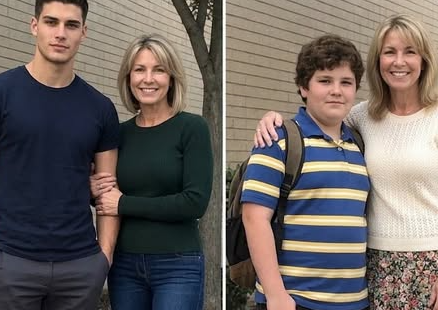
School was never easy for my son.
When the other kids were invited to birthday parties, sleepovers, and weekend get-togethers, he was usually the one left alone. Nobody wanted him on their team. Nobody saved him a seat at the lunch table. And whenever teachers divided the class into groups for projects, he was almost always the last one chosen.
As the years passed, things only got worse.
His classmates laughed at him, played cruel jokes on him, and treated him as though he didn’t belong among them at all.
More than once, he came home pretending everything was fine.
But a mother always knows when her child is hurting.
The hardest part was watching how desperately he tried to become part of the group.
No matter how kind he was to others or how hard he tried, they always found another reason to exclude him.
Then graduation day finally came.
And thankfully, school was behind him.
Ten years passed.
My son built a life of his own. He almost never talked about school anymore, but I knew that some wounds never completely disappear.
A few weeks ago, he learned something that made my heart ache all over again.
His graduating class was organizing a ten-year reunion.
Everyone had been invited.
Except him.
At first, he just smiled.
Then he quietly said:
— You know what? I’m going anyway.
On the evening of the reunion, he put on his best suit and went there without an invitation.
I asked him why he was doing it.
He simply smiled.
— Because it’s time.
At that point, I still didn’t know that he had no intention of asking for their acceptance.
He wasn’t going there for an apology.
He wasn’t looking for closure from old wounds either.
He had his own reason for being there.
By the time Evan arrived at the hotel, the reunion was already in full swing.
Music filled the enormous banquet hall. People were laughing, taking pictures, hugging each other, and reminiscing about their school years.
Then the doors opened.
My son walked in.
Several conversations immediately stopped.
Someone recognized him first.
Then another person whispered his name.
Within seconds, almost the entire room was looking at him.
Ten years earlier, he had been the quiet boy hardly anyone noticed.
Now a confident man stood before them in a perfectly tailored suit.
One of the organizers quickly approached him.
— Evan! Listen, we’re sorry. There must have been some kind of mistake. Maybe your invitation simply never reached you.
My son smiled.
— Of course.
The man looked visibly nervous.
— Really. It was probably just some technical error.
Evan nodded.
— Don’t worry about it.
Then he walked past him.
He didn’t try to find out exactly who had decided not to invite him.
He didn’t demand an explanation.
He didn’t make a scene.
He simply walked into the room.
And I think that was what confused them most of all.
For the next twenty minutes, he calmly talked with people he hadn’t seen in ten years.
Someone told him they had been meaning to contact him for a long time.
Someone else suddenly remembered that they used to sit together in class.
Some even tried to joke about the past.
Evan smiled, listened to them, and moved on.
Then the lights in the room dimmed.
One of the organizers stepped onto the stage with a microphone.
During the evening, they planned to recognize several graduates who had gone on to achieve significant success.
A few names were announced.
There was applause.
Then the host looked down at the paper in his hand.
His expression suddenly changed.
— Actually, he said, there’s one more person we’d like to recognize tonight.
He looked up.
— Evan Carter.
The room became unusually quiet.
My son slowly stood up from his seat.
He walked onto the stage.
And that was when the people in that room learned something they clearly hadn’t expected.
Ten years earlier, Evan had been the boy nobody wanted on their team.
Now he was the founder and CEO of a rapidly growing consulting company.
But that wasn’t all.
The organizer explained that Evan’s company had recently completed a major acquisition of a well-known regional business. The deal was already being discussed in local business circles.
A murmur spread through the room.
The people who had once barely noticed him were now looking at him very differently.
I could imagine what they were thinking.
“When did he accomplish all of this?”
“How did he manage to get this far?”
“Why didn’t we know anything about it?”
But their reactions didn’t seem to impress Evan at all.
He took the microphone.
— Thank you.
He paused for a moment.
— I know some of you are probably wondering why I’m here.
Nobody moved.
— I wasn’t invited.
Someone at the back of the room laughed nervously.
Evan smiled too.
— It’s true.
Then he continued:
— But I didn’t come here to humiliate anyone.
Everyone focused even more closely on him.
— I didn’t come here to prove that I’ve become more successful than the people who once treated me badly.
He paused.
— Because if I did that, it would mean I’m still measuring my life by your standards.
The room fell completely silent.
— For a long time, I thought success was a way to show people that they had been wrong about me.
He lowered his eyes.
— Then I realized something. If you spend your entire life trying to prove your worth to people who once decided you had none, then they’re still controlling your life.
Nobody said a word.
— So I stopped doing that.
Evan looked toward the other side of the room.
A woman was sitting at a small table.
Her name was Mrs. Carter.
For many years, she had worked as a school counselor.
I had often heard my son talk about her.
She had been the only adult at school who truly noticed him.
She was the one who called him into her office one day after another cruel prank.
She was the one who noticed that he had almost stopped eating during lunch breaks.
And she was the one who once told him:
“You don’t have to become someone else just because other people don’t know how to appreciate you for who you are.”
Evan looked directly at her.
— I wouldn’t be standing here today without one person.
Mrs. Carter looked at him, confused.
Evan said her name.
She immediately covered her mouth with her hand.
Evan told everyone how she had helped him through the most difficult years.
How she had supported him.
How she had helped him believe in himself.
How one day she convinced him to go to college when he was certain he wasn’t good enough.
Then my son announced what, as it turned out, had truly brought him to that reunion.
— My company is creating an educational scholarship in Mrs. Carter’s name.
Another murmur moved through the room.
— The program will help cover tuition and essential expenses for students in our district who need financial assistance. But most of all, it’s meant for those kids who feel invisible.
Mrs. Carter began to cry.
Evan continued:
— Because I know what it’s like to believe that nobody sees you.
He looked across the entire room.
— And I don’t want another child to grow up believing that.
For several seconds, there was complete silence.
Then one person stood up.
Another followed.
Then a third.
Within seconds, the entire room was standing and applauding.
But my son wasn’t looking at the people who had once laughed at him.
He was looking at Mrs. Carter.
She was crying.
Evan smiled at her.
And that was when I understood: he had finally found what, perhaps without even realizing it, he had once searched for every morning when he walked into school.
Not their approval.
Not their respect.
Freedom from their opinions.
Evan came home late that night. I was still awake.
He walked into the kitchen, loosened his tie, took it off, and sat beside me.
— So, how was it? I asked.
He smiled.
— Better than I expected.
I was silent for a moment, then asked the question I had been afraid to ask.
— Did it hurt to see them again?
He thought about it.
— Mom, ten years ago, I walked into school every morning thinking there was something wrong with me.
He looked at me.
— Today I walked into that room and realized there was never anything wrong with me.
Tears filled my eyes.
He continued:
— I spent far too many years wishing those people would accept me.
He smiled.
— And today I realized I don’t need their acceptance anymore.
He was about to leave when he suddenly stopped.
— Mom?
— Yes?
He looked at me.
— Do you know what the best part was?
— What?
— Seeing Mrs. Carter cry.
I smiled through my tears.
There was a time when my son came home from school feeling as though nobody cared about him.
Ten years later, he walked back into the same world that had once made him feel like an outsider, and he used his own success to give other children something he had needed so badly himself.
And that was what those people from school had never understood.
They thought that by leaving him off the guest list, they once again had the power to decide whether he deserved to be among them.
But they were wrong.
They had spent years trying to make him feel small.
And while they were deciding who was popular, who mattered, and who deserved a seat at their table, my son was building a life of his own.
A life in which he no longer needed anyone’s permission to know his own worth.
He didn’t go to that reunion to show them how far he had come.
He went because he had finally understood:
he no longer had to return to places where he had once been made to doubt himself.
And there was something even more beautiful.
The boy no one once wanted to make room for at the table had grown into a man who was creating places for others.
They thought they had left him behind.
But the truth was, he had simply grown so far beyond the small life they once imagined for him that he no longer fit inside it.